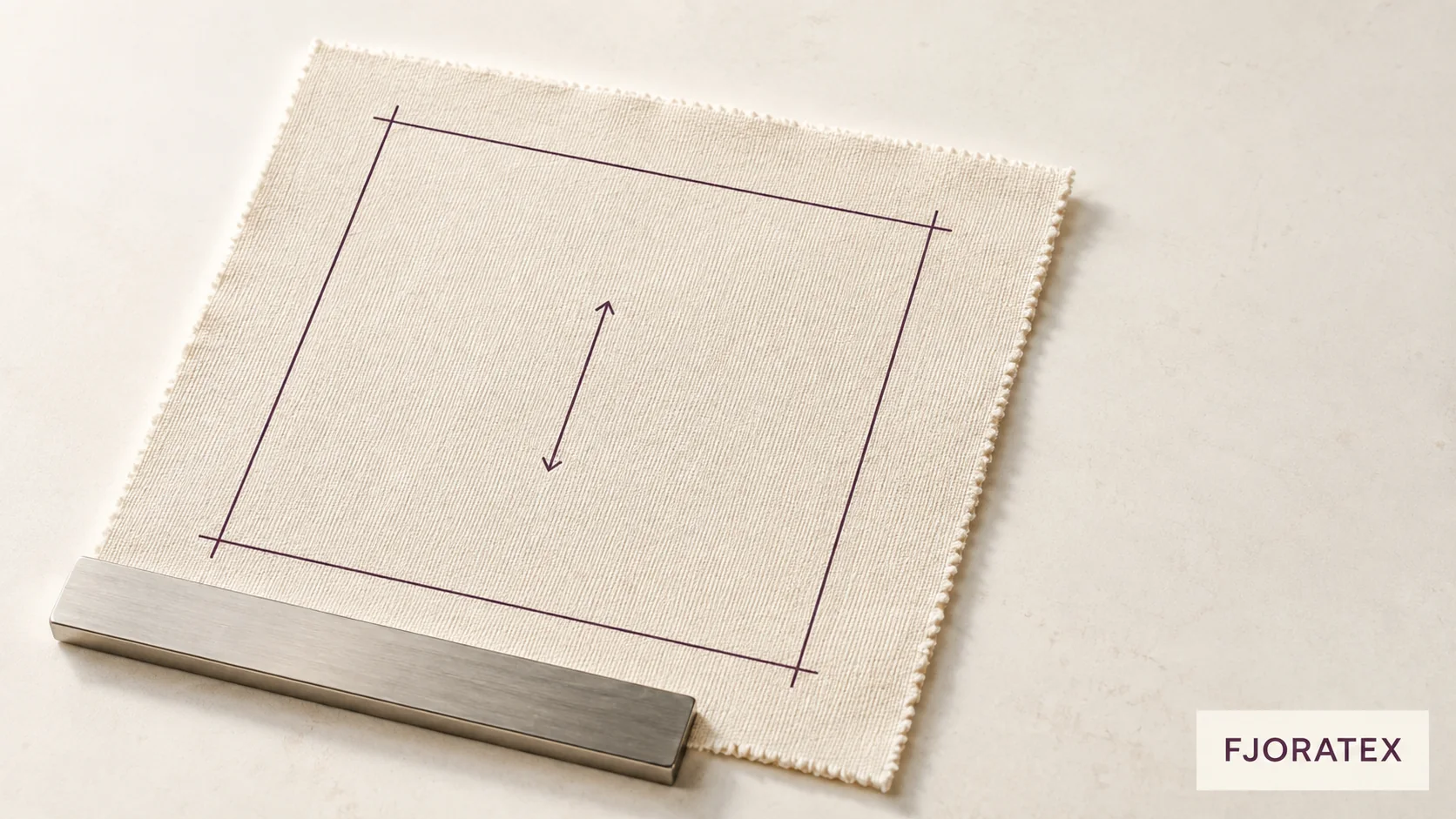
AI-edited image based on a photograph. For illustration only.
Knit fabric shrinkage, growth and wash spirality describe different changes. Read length and width results separately, distinguish fabric testing from garment testing, and check the washing and drying conditions behind every number. A "shrinkage pass" alone does not show that a finished garment will retain its shape or side-seam position.
Did the dimensions change, or did the shape twist?
| Observation | What to assess | What it does not establish |
|---|---|---|
| A garment becomes shorter or wider | Length, width or specified garment measurements | Opposite changes cancel each other out |
| The incoming fabric already has slanted wales | Structure and skew in the received condition | A result for spirality after laundering |
| A fabric specimen twists after washing | Fabric spirality under the selected procedure | Acceptable side-seam appearance in a garment |
| Side seams or trouser legs rotate after washing | Garment spirality and appearance | Acceptability based only on low length shrinkage |
Dimensional change includes growth as well as shrinkage. CottonWorks' technical overview also describes consequences for fit and the relationship between body fabric and trims.
Check the report's sign convention. If change is expressed as the post-treatment measurement minus the original, divided by the original, a negative value indicates shrinkage and a positive value indicates growth. Do not average length and width into a single figure and use it to judge fit.
Why might one shrinkage report list three standards?
The methods can cover different parts of the work:
- ISO 3759:2011 addresses specimen preparation, marking and measurement.
- ISO 6330:2021 provides domestic washing and drying procedures.
- ISO 5077:2007 addresses dimensional change after a specified washing and drying combination.
Several method numbers do not necessarily mean duplicate testing. Ask what was measured, how the sample was washed and dried, and how much it changed. "Tested to ISO: pass" leaves too much unanswered.
Were the washing and drying conditions equivalent?
ISO 6330 includes different machine types and procedures. Its public summary notes that equipment and detergent parameters can affect results; a complete test includes washing and drying.
Matching the temperature is therefore not enough. A line-dried or flat-dried result should not stand in for a tumble-dried one. A measurement after one wash point also does not establish behaviour after an agreed sequence of washes.
A useful test brief records:
- Method edition, washing procedure and drying method.
- Number of wash-and-dry cycles and measurement points.
- Fabric directions or garment locations to be measured.
- Sample finish, colour and batch.
- Allowed change in each direction or location, with the party approving it.
This is a communication checklist, not a laboratory protocol. Select conditions consistent with the proposed care instructions rather than choosing a gentler procedure simply to obtain a smaller result.
What does a spirality or torque result mean?
Ask for the method, specimen type and calculation basis. In this context, "torque" may refer to laundering-related twisting, not a mechanical torque measurement in newton-metres.
ISO 16322-2:2021 addresses fabric spirality after domestic laundering. It provides different procedures and warns that their results are not always comparable. It is not intended to assess spirality in the as-manufactured condition.
ISO 16322-3:2021 addresses garments after domestic laundering. Keep fabric and garment reports distinct. Acceptable length and width changes do not automatically establish acceptable seam alignment.
What should buyers ask when a result is unacceptable?
For cotton knits, CottonWorks links dimensional stability to construction, processing tensions, finishing and care. Treat that as cotton-focused technical background, not a complete explanation for every wool or synthetic fabric. Source
First confirm sample identity and treatment conditions. Then identify the direction, wash point or garment location that missed the requirement. Ask the supplier for a targeted adjustment and assess it again under equivalent conditions.
If preshrinking or a finishing change is proposed, reconfirm delivered width, GSM, handle and price, not only the shrinkage result. Stable, repeatable dimensional change may help a pattern maker assess compensation. Unstable results need further investigation, and seam rotation requires separate attention rather than a blanket size adjustment.
These are proposed development checks, not evidence of a particular failure or a guaranteed correction. Wool-specific considerations are covered in our wool-blend testing guide.
Can the testing work be coordinated to control cost?
Ask the laboratory whether compatible dimensional-change and spirality assessments can share an agreed pretreatment schedule. Confirm the required separate specimens and how each assessment is charged. Do not combine procedures yourself to save a wash cycle.
One planning option is to investigate risks during development, agree conditions on the approval sample, then check bulk batches as specified. Additional colours, wash points and garment checks depend on the product and customer requirements. This is not a fixed FJORATEX acceptance procedure.
Write the treatment, measurement locations, limits and retesting responsibilities together in the specification. FJORATEX is a knit fabric development and sourcing partner; bring the existing report and proposed care instructions to a project discussion.
For an application example, see yoga leggings fabric testing. For the wider report-review process, use our knit fabric test report guide.
Sources
Official method summaries and the CottonWorks overview were checked on 3 September 2026. Acceptance limits need agreement for the product; the sources below do not establish a universal shrinkage or spirality threshold.
- ISO 3759:2011: specimen preparation, marking and measurement
- ISO 6330:2021: domestic washing and drying procedures
- ISO 5077:2007: dimensional change after washing and drying
- ISO 16322-2:2021: fabric spirality after laundering
- ISO 16322-3:2021: garment spirality after laundering
- CottonWorks / Cotton Incorporated: Shrinkage & Skewing
Next Step
Ready to develop your next fabric?
Share your reference or requirements. We can discuss fabric options and how to take the project forward.
Get in touch