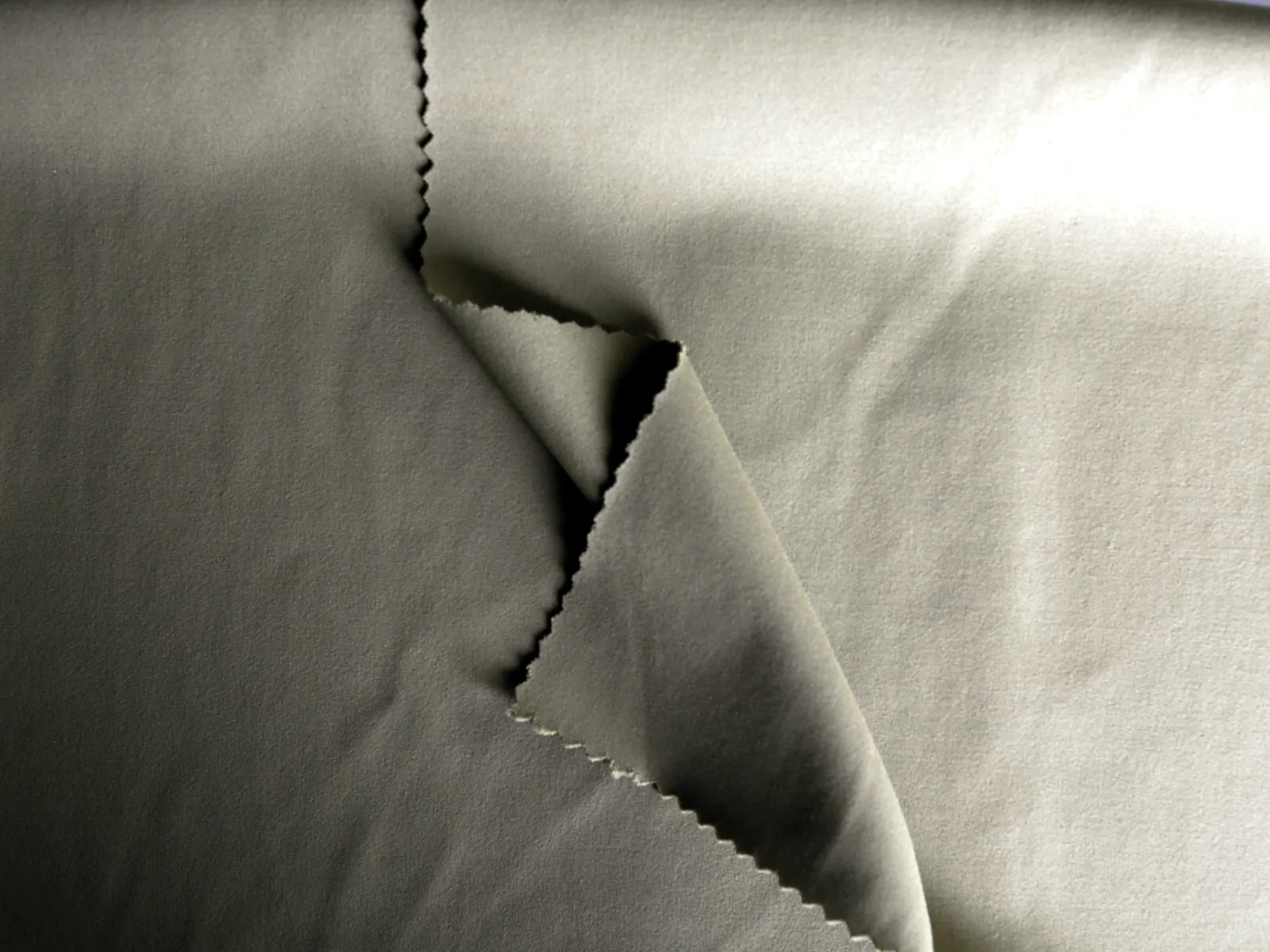
FJORATEX nylon-spandex double-brushed knit. Original fabric photograph showing the brushed surface, cut edges and folds.
Two fabrics can have the same GSM and feel quite different in your hands. One might be lofty, with a raised surface; the other compact and smooth. That difference is easy to miss when comparing samples by their weight specifications alone.
Fabric weight measures mass per unit area; thickness describes the distance between a fabric’s surfaces under a stated pressure. Two finished fabrics with the same GSM can have different yarns, structures and finishes. Those differences can affect thickness and how the fabric bends, compresses and feels against the skin.
Highlights
- GSM and thickness describe different properties. They are related, but one cannot stand in for the other.
- Fabric handle includes several sensations. Ease of bending, fullness under light pressure and surface feel are worth comparing separately.
- Finished fabrics with the same GSM can have different constructions and finishes. Include a reference swatch and intended garment use alongside your target weight.
What does GSM mean in fabric?
GSM stands for grams per square metre, written as g/m². It describes the mass of one square metre of fabric. This is the property measured by ASTM D3776/D3776M, which covers fabric mass per unit area, traditionally called fabric weight. ASTM D3776/D3776M
The number tells you how much material mass sits within a given area. It does not describe how that material is arranged. Even a specification listing both fibre composition and GSM leaves questions about the yarn, knit construction, thickness and surface finish.
Compare fabric weights at the same stage of processing. Identify whether a sample is greige fabric or has completed dyeing and finishing. Keep a target GSM on a sample card distinct from a measured result.
Why can fabrics with the same GSM have different thicknesses?
Thickness depends on more than the dimensions of the yarn. Yarn arrangement, loop shape, layers and raised fibres also contribute. Material can form a compact structure or a more open, lofty one. Equal mass per square metre does not require equal thickness.
In knitted fabrics, yarn size and loop length are separate variables. The way the yarn forms the fabric also affects how it bends and deforms. A study by Varadaraju and Srinivasan examined weight, thickness and tightness as separate structural parameters when analysing the mechanical properties of knitted fabrics. Knit structure and mechanical properties Our guide to single jersey vs interlock explains some of the differences between these two common constructions.
Finishing can alter the surface too. Napping raises fibres to create a pile, while sanding or sueding changes the surface texture and feel. CottonWorks describes these processes in its guide to mechanical finishing.
There is an important distinction here: two finished fabrics sharing the same GSM does not mean that a fabric’s GSM stays unchanged during finishing. Mechanical compaction, for example, reduces fabric length and changes its structure; mass per unit area and thickness can increase as a result. Finishing can therefore change both handle and weight. CottonWorks: compaction
Thickness measurements also depend on pressure. A lofty fabric compresses when pressed, changing the measured distance between its surfaces. ASTM D1777 requires the pressure to be specified when discussing thickness. Before comparing two thickness results, check that the measurement conditions are comparable. ASTM D1777
Why can fabrics of similar thickness still feel different?
“Soft” can mean several things. One person wants a fabric that bends easily. Another likes a full, cushioned feel when pressing it. Someone else is mainly concerned with how smooth the surface feels against their fingertips.
These qualities contribute to fabric handle, meaning how a fabric feels when handled. Research on next-to-skin Merino knits has assessed smoothness, hairiness, softness and tightness as separate attributes. A single weight or thickness value cannot describe them all. Mahar and Wang: evaluating fabric handle
When comparing swatches, ask three practical questions:
- Bending: Does the fabric fold and bend easily?
- Compression: Does it feel full under light pressure, and how does it recover when released?
- Surface: Does it feel smooth, finely raised or distinctly textured?
These observations help identify which part of the feel you want to retain or change. If you like a raised surface, describe its arrangement as well. Grid fleece, for example, has raised fleece sections separated by lower channels. GSM alone does not describe that structure.
Does higher GSM mean better fabric quality?
GSM can be a specification requirement; it cannot establish a quality grade on its own. A fabric that falls outside an agreed weight range may need adjustment. A lighter fabric developed for a different use is not automatically lower quality.
GSM remains useful for narrowing a selection, particularly when comparing fabrics with similar fibre composition, yarns, construction and finishing. Across different fabric types, however, weight alone cannot establish which will be softer, more durable or better suited to a garment.
If abrasion resistance, pilling or dimensional change after washing matters to the project, specify those requirements separately. Check which material was tested, by which method and under which conditions. Our guide to reading a knit fabric test report explains what to look for.
How do you describe the fabric feel you want in a development brief?
Start with the intended garment, then use a reference swatch to explain what you want to keep and what should change. For example:
For a long-sleeve next-to-skin top. Aim for a GSM close to reference sample A and retain its drape, with a smoother, less hairy surface. Please specify the proposed fibre composition, yarn and knit construction, and provide a sample that has completed the intended dyeing and finishing processes.
This gives “make it softer” a more specific direction and gives both sides a shared reference. Describe the particular sensation you want to change.
When samples arrive, compare corresponding faces and directions at the same processing stage. If the feel after washing matters, wash according to the intended care conditions and record the differences before and after.
FJORATEX supports knitted fabric development and supply chain coordination. Bring a reference swatch, target GSM, garment use and the specific change in feel you want to your sampling discussion.
Next Step
Ready to develop your next fabric?
Share your reference or requirements. We can discuss fabric options and how to take the project forward.
Get in touch