Single Jersey vs. Interlock: Choosing the Right Knit Structure for Performance Apparel
June 21, 2026
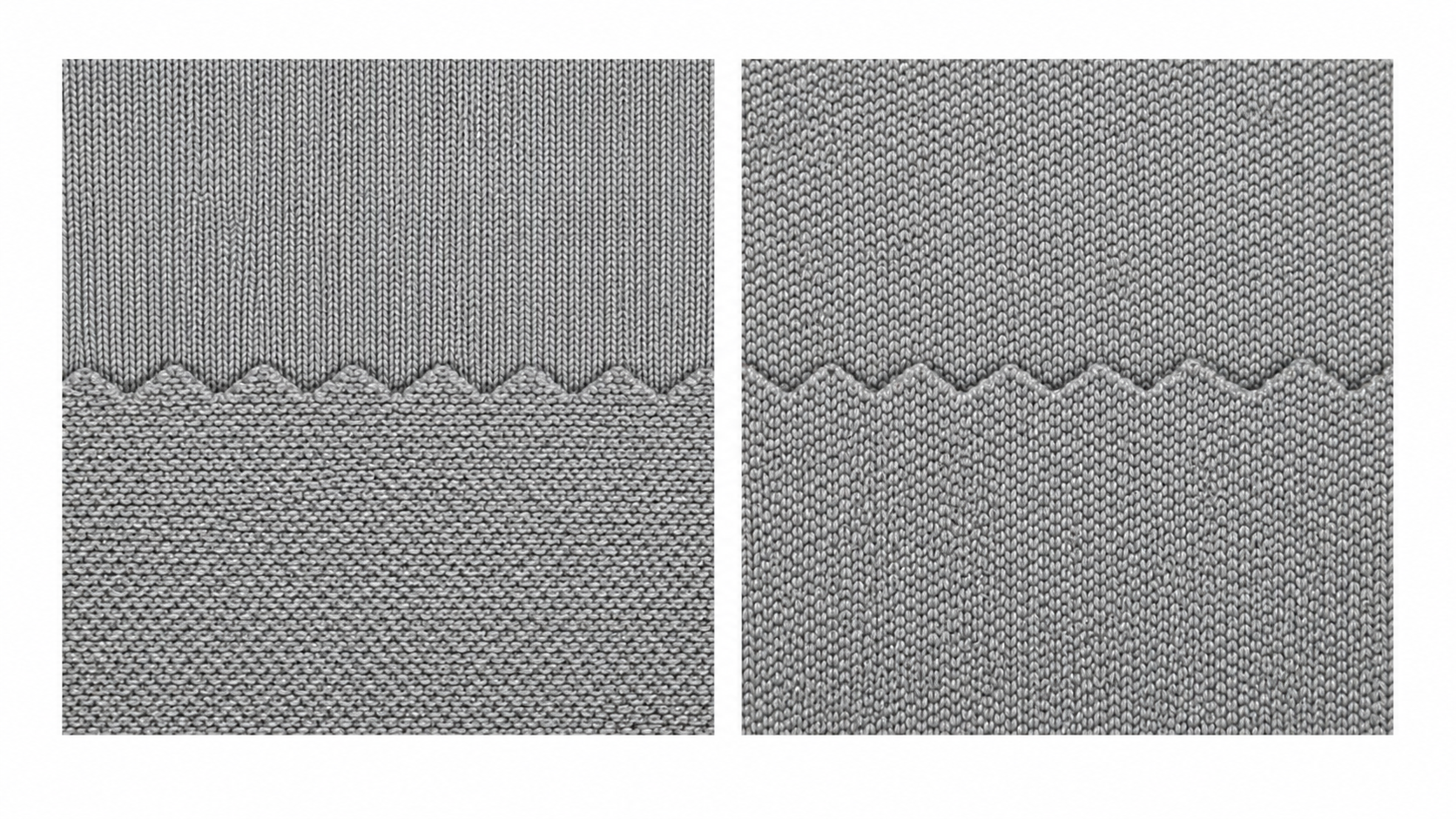
Left: single jersey (technical face, V-shaped loop pattern). Right: interlock (uniform surface, identical on both faces).
Single jersey and interlock are the two most widely used circular knit constructions in performance apparel. Both appear across categories — running tops, training wear, golf polos, base layers — and both can be engineered in polyester, nylon, merino wool, and blended constructions. Despite how frequently they appear together in fabric discussions, they are structurally different fabrics that behave differently in use and in production.
Understanding the distinction helps brands make more deliberate development decisions rather than defaulting to a construction that may not match the product's performance requirements.
How Each Structure Is Built
Single jersey is produced on a single-cylinder circular knitting machine. Each course of yarn forms interlocking loops in one direction, creating a fabric with a distinct technical face — the smooth V-shaped knit stitches — and a reverse that shows the purl loops. The structure is inherently asymmetrical. Single jersey is the most widely produced circular knit construction globally, used across everything from basic T-shirts to high-performance running tops.
Interlock is a double-knit construction. Two mirrored beds of single jersey are knitted simultaneously and interlocked so that the purl loops of each layer face inward, toward each other. The result is a fabric that presents a smooth, consistent face on both sides, with no visible reverse. Interlock behaves more like a unified, stable sheet than a single-sided stretch fabric.
These are not simply two weight variants of the same fabric. The structural difference changes stretch behavior, dimensional stability, edge behavior, and the range of yarn and fiber combinations that work well in each.
How to Tell Them Apart on a Sample
When evaluating a physical fabric swatch, two quick checks are usually enough.
The two-face test: flip the fabric over and look at both sides. Single jersey has a clearly different front and back — the technical face shows smooth V-shaped loops, the reverse shows textured purl bumps. Interlock looks identical on both sides; the stitch pattern and surface are the same whichever face is up.
The stretch-and-curl test: grip the fabric from both selvedges and stretch it horizontally. Single jersey will curl inward along the stretched edge — this is an inherent property of the asymmetric structure. Interlock does not curl. This is also why interlock is the preferred construction for free-cut and laser-cut garments, where a stable, non-curling edge matters during production.
If neither test is conclusive from a sample alone, ask the supplier to confirm the knitting structure and gauge. A correctly documented fabric should carry this information as standard.
Key Differences in Practice
Weight and GSM
Single jersey for performance apparel typically runs between 120 and 180 GSM. It produces a lighter, more fluid fabric that works well as a standalone top in warmer conditions.
Interlock starts around 170–180 GSM and more commonly lands in the 200–260 GSM range for structured end uses. The doubled construction adds physical substance. For garments where opacity, a more substantial drape, or a polished surface matter — golf polos, training tops meant for both sport and post-sport wear — interlock's added weight and body usually reads better.
Stretch and Recovery
Single jersey stretches significantly in the cross-direction (widthwise), often 70–100% or beyond, with more moderate recovery. The fabric moves freely with the body, which is an advantage in dynamic applications.
Interlock has a more contained stretch range — typically 30–60% crosswise — but the double structure provides better dimensional recovery and retains its shape after repeated wearing and laundering more reliably than single jersey at equivalent GSM. For garments where shape retention over a product's life matters, this is a meaningful difference.
Surface and Hand Feel
Single jersey has a softer, more yielding drape. The fabric moves with less resistance and feels lighter against skin. In fine polyester or nylon constructions at 28G–36G gauge, it can achieve a very smooth surface.
Interlock has a firmer, more uniform hand. Both faces are identical, and the surface has a matte evenness that some categories — golf polos, structured training tops, layering pieces — specifically require. Brands that want a fabric to look clean and stay pressed after washing typically prefer interlock.
Edge Behavior
Single jersey cut edges curl toward the technical face. This is a structural characteristic, not a quality issue, but it affects patternmaking and construction. Garments developed in single jersey often require specific seam treatments, binding, or overlock approaches to manage curl at hems and necklines.
Interlock cut edges are dimensionally stable and do not curl. This simplifies construction and can reduce labor cost at the sewing stage, which is relevant at scale.
Where Each Structure Fits by End Use
Single Jersey
Running tops and trail shirts are the clearest single jersey territory. Light weight, free movement, and effective moisture management when made with fine polyester or nylon yarns are all characteristics single jersey provides well. Yoga tops, Pilates wear, athleisure T-shirts, and lightweight next-to-skin base layers in merino or nylon blends also typically land in single jersey.
For any garment where stretch range, next-to-skin softness, and weight minimization are priorities, single jersey — particularly at 28G and above — is usually the appropriate direction.
Interlock
Golf polos, structured training tops, base layers with a more defined silhouette, and transitional activewear (garments intended for both sport and casual contexts) tend to favor interlock. The fabric's stability holds clean pattern lines at the collar and placket, and the uniform surface reads as a premium finish in most buyer contexts.
For brands developing uniform programs, corporate sportswear, or team outfitting, interlock's dimensional stability after repeated laundering makes it a more reliable specification than single jersey.
Gauge: What the Numbers Mean
On a circular knitting machine, gauge refers to the number of needles per inch on the cylinder. Higher gauge = finer needle spacing = finer, denser fabric.
| Gauge Range | Typical Application |
|---|---|
| 18G–24G | Casual jersey, sweatshirt fabric, waffle thermal constructions |
| 28G–32G | Standard performance jersey and interlock for activewear |
| 36G–40G | Fine-gauge performance knits, lightweight running and base layer constructions |
Gauge choice interacts with yarn selection and fiber content to produce the final fabric character. A 28G machine running a textured recycled polyester yarn produces a different fabric from the same gauge machine running a smooth microfiber nylon — even at a similar GSM and construction. When briefing a supplier, confirming the gauge alongside GSM and fiber content prevents misalignment early.
What to Specify When Briefing a Supplier
When developing a jersey or interlock fabric, the following information should be established before sampling begins:
- Construction: single jersey or interlock — be explicit; "knit fabric" is under-specified
- Gauge target: indicates fineness and determines machine capability
- GSM target and tolerance: e.g., 160 GSM ±10 GSM
- Fiber content and blend ratios: e.g., 88% polyester / 12% spandex
- Shrinkage requirement: typically ≤3% after laundering, confirmed by wash test
- Stretch and recovery targets: particularly if compression or shape retention over time matters
- Color fastness standard: ISO 105 or AATCC depending on market
- Reference sample (if available): significantly reduces development cycles
A physical reference fabric shortens the development process. Mills can work toward a target hand feel, weight, and surface appearance more reliably with something to match against than from a written brief alone.
How FJORATEX Can Support This
FJORATEX works with both single jersey and interlock constructions across polyester, nylon, and wool-blend fiber directions. For brands developing performance garments — running tops, training polos, base layers, or structured activewear — development support covers brief interpretation, fabric sourcing and sampling, and production coordination.
If you have a reference sample or a technical brief, share it via the contact form. We'll provide a development assessment and an initial timeline.
Next Step
Ready to develop your next fabric?
Share your brief and we'll evaluate technical fit, timeline, and feasibility within one business day.
Initiate a Project