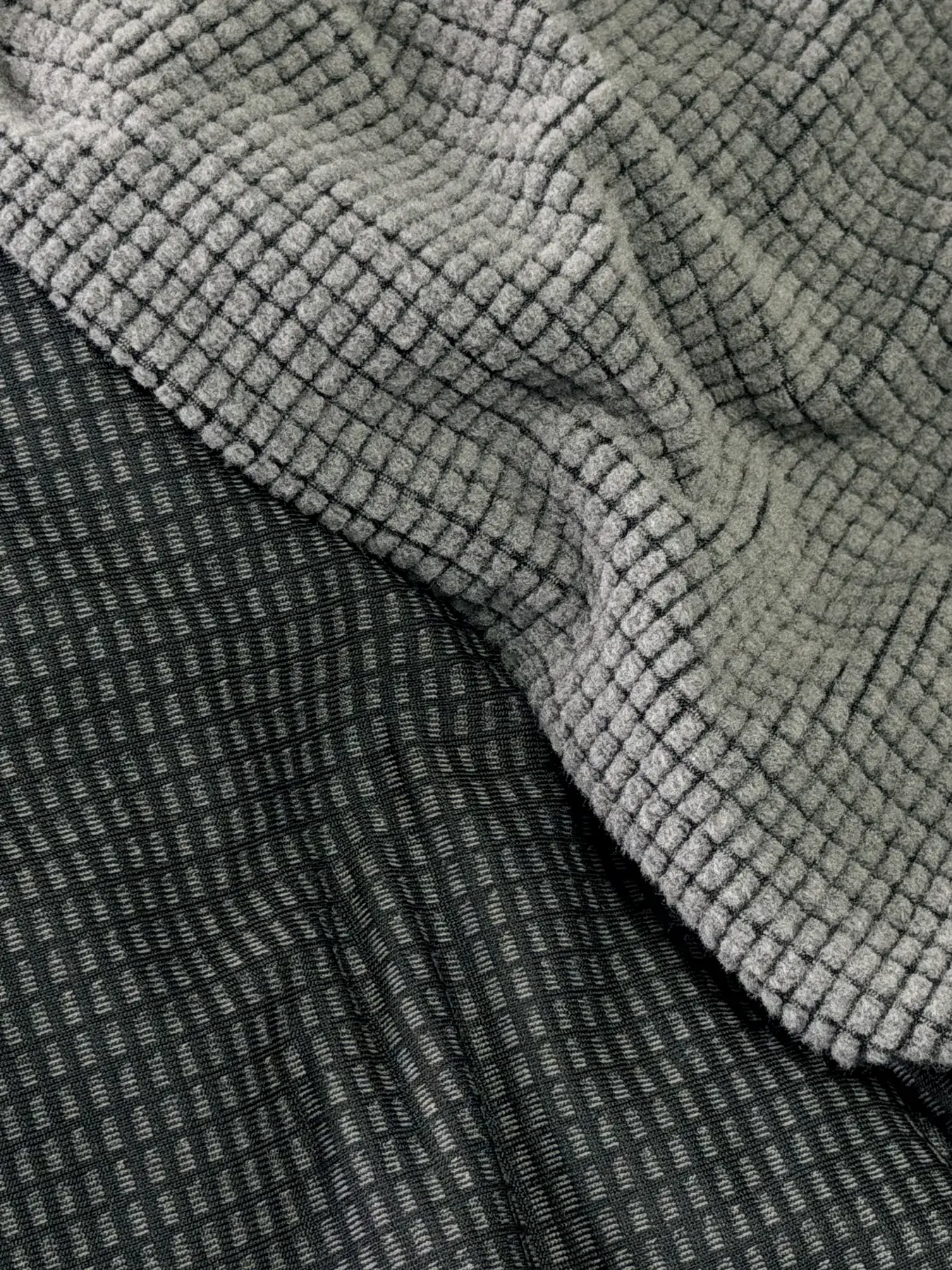
FJORATEX grid fleece, 200 g/m². Original fabric photograph showing the raised pile, recessed channels and reverse face.
Look closely at grid fleece and the surface breaks into small blocks: raised patches of soft pile, separated by lower channels. If fleece is meant to keep us warm, why leave those channels in the first place?
Grid fleece fabric combines raised areas of pile with lower channels to adjust the balance of insulation, bulk and airflow. The raised sections retain air within the pile; the channels change how that pile covers the fabric. Performance still depends on the yarns, underlying knit, finishing and intended use.
What do the raised squares and channels do?
Fleece insulation relies partly on the air held within its pile. The lofted fibres create small air spaces that help slow heat loss from the body. Polartec describes this relationship between raised pile and trapped air in its explanation of traditional fleece construction.
A grid structure keeps areas of loft while introducing lower channels between them. In Polartec Power Grid, the spaces between the raised sections are designed to encourage airflow and reduce bulk. It is one way to distribute the pile around a garment's intended use without making the whole surface uniformly thick.
Those channels are not necessarily holes through the fabric. The underlying knit and finishing still influence how easily air can pass through it, as ASTM D737's guidance on air permeability explains. Surface texture alone gives an incomplete picture of construction. Our comparison of single jersey and interlock looks more closely at the underlying knit structures.
How does grid fleece compare with regular fleece?
The useful comparison starts with the garment.
For a layer worn during sustained activity, the brief might prioritise some insulation, less bulk and the release of excess heat and moisture. A garment intended to keep someone warm during long periods of low activity may need a different balance. The two uses need not lead to the same fleece construction.
When comparing grid fleece with a fleece that has a more continuous pile surface, check the conditions behind the comparison. Are the fabrics similar in weight, composition and thickness? Will they sit next to the skin or underneath a shell? Without that context, claims such as “warmer” or “more breathable” can compare quite different products.
Grid size is not a performance rating either. Large squares, small squares, deep channels and shallow channels describe geometry. Choosing between them requires the full specification and physical samples.
Does the grid make a fleece moisture-wicking?
Air passing through a fabric, water vapour moving through it and liquid sweat spreading along its yarns are different processes.
Alongside its explanation of the grid, Polartec describes the role of a bi-component knit in moving moisture through Power Grid. That distinction matters: similar-looking squares do not establish that another fabric will wick or dry in the same way. Source: Polartec Power Grid
For development, separate “breathable”, “wicking” and “quick-drying” into specific questions. If the concern is airflow, examine air permeability. If it is water-vapour transfer, assess the relevant vapour resistance. If the priority is drying after sweating, request a drying test suited to that claim.
How should buyers choose a grid fleece fabric?
Start with a concrete brief. For example: “A hiking midlayer worn under a shell, with less bulk.” That gives a sampling discussion more direction than asking for a fleece that is simply lightweight, warm and breathable.
Compare both faces of the samples, pile height, channel layout, fabric weight and stretch. Then assess them in the intended layering arrangement. Where performance needs verification, select the test around the question: ASTM D737 measures air permeability; ISO 11092:2026 specifies measurements of thermal and water-vapour resistance under steady-state conditions. These methods answer different questions. Our guide to reading a knit fabric test report explains how to check the sample, method and conditions behind a result.
The grid fleece sample in FJORATEX's fabric library is listed at 200 g/m². Its photograph shows the raised blocks, recessed lines and reverse face, providing a physical starting point for discussing the structure. FJORATEX is a knit fabric development and sourcing partner that supports development from a reference sample and product brief.
Bring the reference swatch, target weight, layering position and the problem you want to solve into the same discussion. “Reduce bulk while retaining some insulation” gives the choice of grid size and depth a practical purpose.
Next Step
Ready to develop your next fabric?
Share your reference or requirements. We can discuss fabric options and how to take the project forward.
Get in touch