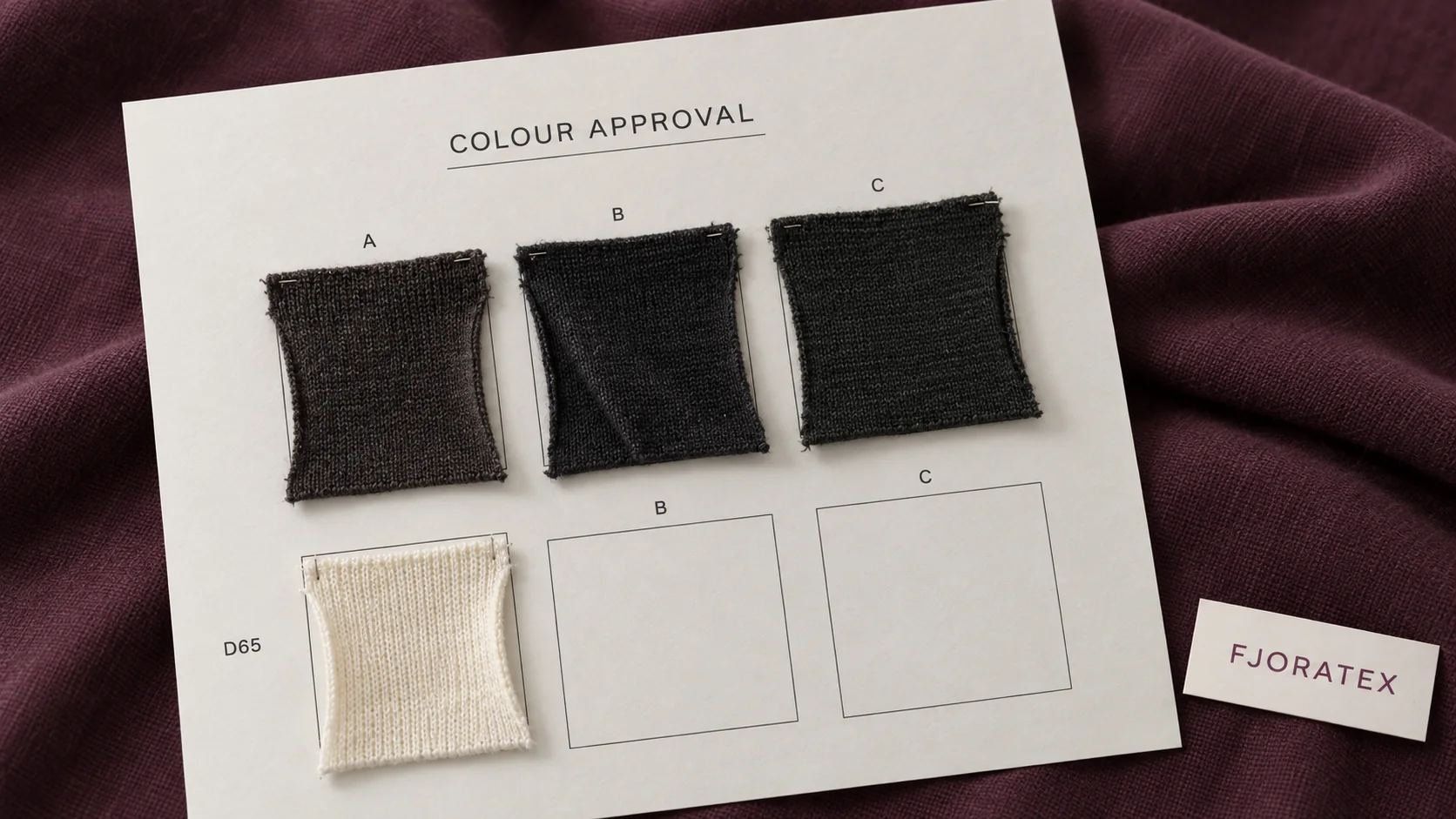
AI-assisted editorial reconstruction based on a real wool yarn colour approval sheet; identifying supplier and project details were removed.
During a recent wool knit development, we received a yarn colour approval sheet before knitting began. Three dark options, labelled A, B and C, looked almost identical in photographs. The physical samples made differences in depth and undertone easier to judge.
The decision at that point covered the yarn shade. It did not approve a fabric that had not yet been knitted and finished.
"Colour approved" is only useful when the record identifies what was approved. It should name the object and stage, the physical standard, the viewing or measurement conditions, the version and the date. Approval at one stage does not automatically approve the next.
What exactly has been approved?
An approval can become surprisingly vague once a project moves forward. One person may mean the yarn submission, another the first knitted fabric, and someone else a production lot. If the record says only "approved", the comparison standard can be difficult to reconstruct a few weeks later.
Separate the objects first:
| Approval object | What the decision can establish | What it cannot establish automatically |
|---|---|---|
| Yarn shade sample | Whether the submitted yarn shade can move into development under the agreed viewing conditions | That the knitted and finished fabric appearance is approved |
| First or confirmation fabric | Whether that yarn, knit construction and finishing combination gives an acceptable colour | That every later production lot will be identical |
| Specific bulk lot | Whether the reviewed lot meets the agreed comparison requirement | That the next lot needs no review or that every roll is naturally uniform |
This is a framework, not a mandatory three-step rule. A buyer and supplier may use fewer or more approval points. Each decision still needs a named object.
What do A, B and C mean on a colour approval sheet?
On this sheet, A, B and C identify three candidate shades. They help both sides refer to the same sample. They are not international quality grades, and A does not mean best while C means worst.
Keep the selected physical sample with the decision record. An email saying "approve B" is less useful if the card or swatch that defined B later goes missing.
The sheet should not automatically be called a lab dip either. A lab dip, a dyed yarn sample and a finished fabric swatch can refer to different approval objects. State what the submitted material actually is instead of relying on one familiar term.
What is D65, and why should the record include it?
The sheet used in this project specifies D65. ISO/CIE 11664-2:2022 defines CIE standard illuminant D65 as a representation of average daylight with a correlated colour temperature of approximately 6,500 K.
Recording D65 tells the parties which reference illumination was used for viewing or measurement. It does not mean "look at it somewhere near a window", and it cannot remove every difference between light boxes, surroundings, samples or observers.
Photographs were useful for discussing the candidates in this project. The physical samples remained the basis for the final comparison. A photograph can support the record, but it is a poor substitute for the agreed physical standard.
Should buyers trust visual assessment or instrument data?
They answer different parts of the question. AATCC EP9-2025 covers the visual assessment of colour differences between a textile material and a standard. AATCC EP6-2021 addresses instrumental colour measurement of textile specimens.
Instrument data makes colour easier to describe and compare. ISO/CIE 11664-4:2019 specifies the calculation of CIE 1976 L*a*b* coordinates and includes a colour-difference measure based on distance in that space. ISO 105-J03:2009 covers the calculation of colour differences between specimens of the same material measured under the same conditions.
A colour-difference formula does not set the commercial pass line. ISO 105-J03 allows a maximum difference to be specified according to the closeness of match required for the end use; it does not give one universal tolerance for every yarn, shade or brand. The buyer and supplier still need to agree on the formula, measurement conditions, reference sample and acceptance requirement for the project.
Visual assessment and instrument data can support each other. Their role depends on the material, the buyer's specification and the approval stage.
Why review the fabric after approving the yarn shade?
The approval in this example took place before knitting. At that moment, the final fabric did not exist, so the sheet could only confirm the submitted yarn shade.
Once the yarn has been knitted and finished, the buyer is looking at a new object. The fabric needs to be checked against the target and retained physical standard, with the new decision added to the project record.
The same caution applies to bulk production. An approved fabric can become the comparison standard for later material, but it cannot represent every future lot automatically. Any lot, roll or representative-sample review should follow the order requirements and the agreement between the parties.
What should a traceable colour approval record contain?
| Record item | Why it matters |
|---|---|
| Approval object and stage | Distinguishes yarn, fabric, garment sample and bulk lot |
| Article, colour and version reference | Ties the decision to the correct submission; sensitive data can remain in the private project file |
| Retained physical standard | Gives later yarn, fabric and production comparisons a common reference |
| Viewing illumination and surroundings | Reduces arguments caused by different observation conditions |
| Instrument method and conditions | Makes L*a*b* or colour-difference data comparable |
| Acceptance requirement and its source | Separates buyer specifications, contract terms and supplier controls |
| Approver and date | Keeps the decision out of disconnected chat messages |
| Next review point | States what still needs confirmation at fabric or production stage |
When colour data appears in a laboratory report, also check the sample identity, method, conditions, requirement source and actual result. Our guide to reading a knit fabric test report explains that sequence in more detail.
What does colour approval not prove?
Colour matching and colourfastness answer different questions. A sample may look close to the target under D65 without proving how it will change or transfer during washing, rubbing, perspiration or light exposure. ISO 105-A01:2010 provides general information on colourfastness testing methods, their uses and limitations.
A colour approval sheet therefore cannot, by itself, establish colourfastness, fibre composition, lot consistency or other fabric performance. The product use, target market, buyer specification and contract should determine which further checks are needed. Our article on pilling, abrasion and rubbing colourfastness shows why similar-looking test terms should not be treated as substitutes.
Where can FJORATEX take part?
FJORATEX is a knit fabric development and sourcing partner. Once a brand supplies the target colour, physical standard and intended end use, we can help identify the current approval object, coordinate samples across yarn, knitting and finishing stages, and keep the decisions connected in the project record.
FJORATEX does not impose one colour tolerance on every project or make unilateral acceptance decisions for the buyer, supplier or laboratory. Approval points, methods and acceptance requirements remain project-specific.
To discuss a colour-sensitive knit development, contact FJORATEX with the intended product, material, target shade and any available physical standard.
Frequently asked questions
Does yarn shade approval mean the finished fabric colour is approved?
No. It confirms the submitted yarn shade at that stage. Knitting, finishing and bulk production create new comparison points that may require separate approval.
Is D65 the same as ordinary daylight?
No. D65 is a defined standard illuminant representing average daylight. A casual window-side check does not reproduce a controlled D65 assessment.
Is there one acceptable Delta E limit for every textile order?
No. The calculation method and the commercial acceptance tolerance are separate. The relevant requirement needs to be agreed for the material, end use and buyer specification.
Can a photograph be used for colour approval?
A photograph is useful for discussion and documentation, but cameras, screens and lighting alter colour appearance. Keep an agreed physical standard for the approval decision whenever the project requires accurate shade matching.
Sources
The public summaries below support the method descriptions in this article. They do not replace the full standards, the buyer's specification or the contract. Sources checked on 14 September 2026.
- ISO/CIE 11664-2:2022: CIE standard illuminants
- ISO/CIE 11664-4:2019: CIE 1976 L*a*b* colour space
- ISO 105-J01:1997: general principles for measurement of textile surface colour
- ISO 105-J03:2009: calculation of textile colour differences
- AATCC EP6-2021: instrumental colour measurement
- AATCC EP9-2025: visual assessment of colour difference
- ISO 105-A01:2010: general principles of colourfastness testing
Next Step
Ready to develop your next fabric?
Share your brief and we'll evaluate technical fit, timeline, and feasibility within one business day.
Initiate a Project