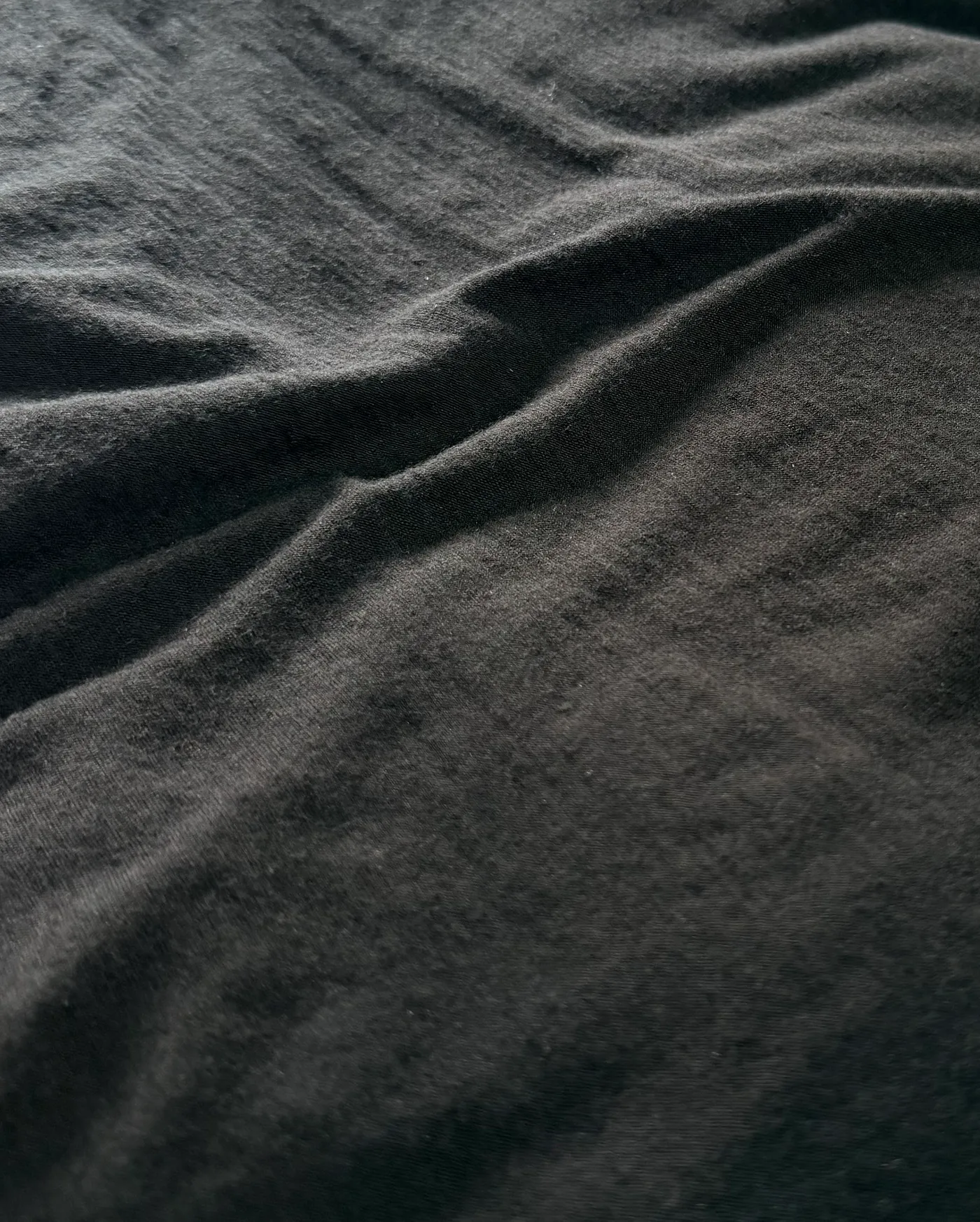
Wool-nylon core-spun single jersey from the FJORATEX fabric library: 87% wool, 13% nylon, 145 gsm.
We recently checked twist levels with XINAO and Yangtse Spinning for comparable wool yarns. XINAO, based in Tongxiang, Zhejiang, China, produces worsted wool yarns. Yangtse Spinning, based in Zhangjiagang, Jiangsu, is a subsidiary of Germany’s Südwolle Group.
For the specifications discussed, XINAO’s yarn had a higher twist level.
The difference was specific to those yarns, but it raised a useful question for wool-blend development: how should a twist specification be evaluated alongside the fabric it will become?
An earlier single-jersey project gives that question some practical context. The fabric was made with 87% wool and 13% nylon core-spun yarn, specified at 145 gsm and 165 cm wide. During development, we worked with our partner knitting mill and dyehouse to bring spirality and shrinkage within the project’s requirements.
What the twist number tells us
Twist holds fibres together within a spun yarn. Higher twist can improve fibre cohesion and help control hairiness and pilling. Woolmark’s pilling guidance identifies yarn twist, fibre length and fabric cover as relevant design factors.
For a lightweight wool blend, these properties matter alongside softness and the intended fabric handle. A higher twist specification is useful information, though finished-fabric performance still needs to be checked.
Single jersey also requires attention to residual torque: the yarn’s tendency to rotate as it relaxes. That movement can distort the loops and make the stitch columns lean. Woolmark’s Introduction to Knitwear explains the importance of twist balance in controlling fabric skewing.
Twist level and residual torque describe different properties. Yarn construction and treatment influence how they relate, while stitch length and wet processing also affect the behaviour of the knitted fabric.
Following the fabric through knitting and finishing
On the wool-nylon project, we reviewed the knitting setup with our partner mill and adjusted the cam settings and stitch length before knitting new trial fabric.
Those changes then needed to be assessed through dyehouse trials. We spent several days following the work at the dyehouse, discussing the results and further adjustments with the team. The knitting settings were evaluated alongside the fabric’s response to wet processing.
After three washes, each followed by flat drying in the shade, the trial fabric met the project’s requirements for spirality and shrinkage in both length and width.
That result covered the trial fabric under the conditions used. The washing and drying sequence remained part of the basis for judging it.
Comparing yarns for a development brief
For brands comparing wool-blend yarns, composition, yarn count, construction and twist are useful starting points. Sampling connects those specifications to the intended knit structure, finished weight, handle and care requirements.
In our project, reaching the required result involved work across knitting and finishing. The XINAO and Yangtse discussion highlights why a yarn comparison becomes more useful when it includes that wider development context.
For guidance on defining wash conditions and interpreting results, see our knit fabric shrinkage and spirality guide.
Next Step
Ready to develop your next fabric?
Share your reference or requirements. We can discuss fabric options and how to take the project forward.
Get in touch