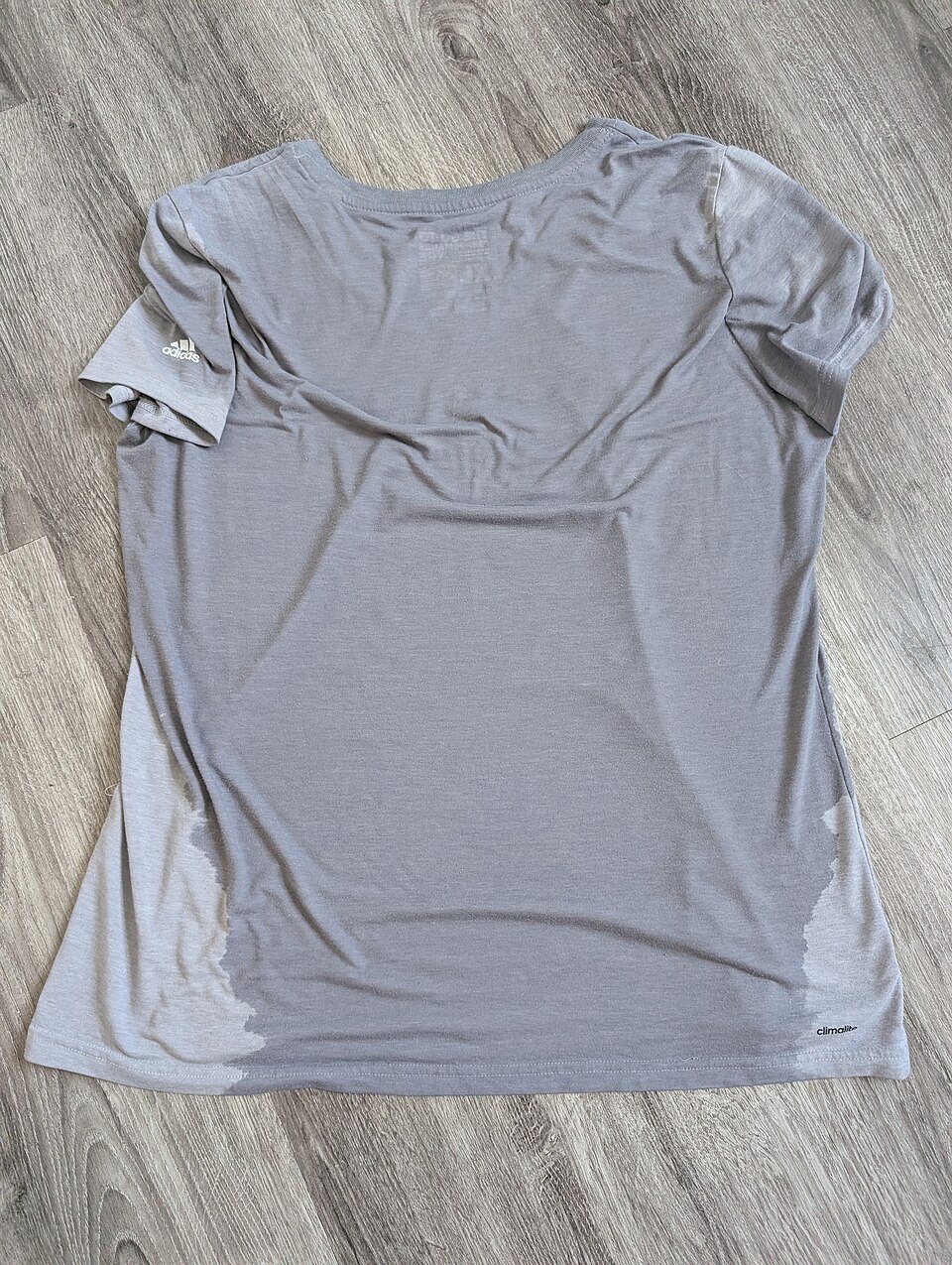
Darker, sweat-wetted fabric beside lighter dry areas on the same T-shirt. Photograph by Hannah Clover, CC BY-SA 4.0; full image credit below.
A drop of water lands on a shirt and leaves a dark spot. After exercise, similar patches may appear across the back or around the neckline. Water is clear, so why does it seem to change the colour of the fabric?
Fabric often looks darker when wet because water changes how light travels between its fibres. Less light is scattered back, while more may enter the fabric and be absorbed by dyes. Some fabrics also become more see-through. This change in appearance alone does not establish colourfastness or tell you how quickly the fabric will dry.
Highlights
- Wet darkening can be an optical effect. A deeper-looking colour does not necessarily mean the dye has changed.
- Colour, transparency and viewing conditions all matter. Different fabrics can change in different ways when wet.
- Less visible sweat marks do not mean faster drying. Appearance, moisture movement and drying time need separate assessment.
If water is clear, why does it make fabric look darker?
Fabric contains many fibres, with small spaces between them. When the fabric is dry, light is reflected and refracted at the boundaries between fibres and air. Some of that light is scattered back towards our eyes.
Water entering those spaces changes how light behaves. The difference in refractive index between water and a fibre is usually smaller than the difference between air and that fibre, so less light is reflected at these boundaries. In dyed fabric, more light may travel into the material, giving the dye more opportunity to absorb it. The fabric can then look darker.
This can happen without any change to the dye itself. Research on wet, rough materials relates reduced reflectance to changes in relative refractive index and the paths light takes before escaping or being absorbed. Water does not have to add colour to change what we see. Lekner and Dorf, Applied Optics, 1988; Cui et al., AATCC Journal of Research, 2026.
Does every fabric become noticeably darker when wet?
Not necessarily. Wetting can affect lightness, colour intensity and how much of the background shows through.
A 2026 study examined polyester double-knit fabrics in different colours and depths of shade. Observers perceived stronger colour differences when the moisture contrast between samples was greater. Their judgements of lightness were also more consistent than their judgements of colour intensity or hue. Of course, the researchers tested a specific set of polyester fabrics. That does not give us a universal ranking of which fibres and colours show sweat marks most clearly. Read the study.
White fabric offers another useful example. When wet, it may become more transparent, allowing skin or clothing underneath to show through. A darker background can make the wet patch appear darker; a different background can change the effect. Physicist Christopher Baird at West Texas A&M University explains this using a white shirt. Why does water make a shirt darker?.
For fabric selection, a swatch that shows little change on a white table is still worth checking against a background closer to how it will be worn. This is a practical visual check, rather than evidence that the finished garment has passed an opacity test.
Does a darker wet patch mean the fabric is losing dye?
Wet appearance describes how fabric looks while it contains water. Colourfastness concerns how well its colour withstands a specified exposure. For example, ISO 105-E01 addresses the resistance of textile colour to immersion in water. ISO's official scope.
If the fabric looks the same again once it has dried, the change you observed was reversible. That alone does not mean it has passed a colourfastness test for water or perspiration. Equally, a mark that remains after drying, or any colour transfer, needs further investigation. It should not automatically be attributed to the optical effects of wetting.
Does fabric that hides sweat marks dry faster?
You cannot tell from appearance alone. The darkness of a wet patch shows the visual contrast between wet and dry areas. It does not directly tell you how much water the fabric holds, how that water moves or how long it takes to dry.
AATCC lists liquid moisture management and drying as separate test methods. TM195 assesses the liquid moisture management properties of textile fabrics, while TM201 assesses drying rate using a heated plate. The appropriate method still needs to suit the intended product and agreed requirements. AATCC's official test method directory.
For a fabric brief, treat less visible sweat marks and faster drying as two separate requirements. Whether wet fabric clings to the body is another question, covered in our article on wet cling in activewear fabrics.
How should you assess wet appearance when choosing activewear fabric?
Start with the colour you intend to use. Compare the same finished fabric in three states: dry, locally wetted and dried again. Keep the lighting, background and viewing angle as consistent as possible, and record the amount of water applied and when you make each observation. If you take photographs, try to keep the exposure settings consistent too.
Look beyond whether the fabric becomes darker. Consider how clearly the edge of the wet patch stands out, whether the wet area becomes more see-through and whether any marks remain after drying. If you plan to offer several colours in the same fabric, check each one rather than assuming that one colour represents the whole range.
A comparison using plain water can help a team discuss its expectations for appearance. It does not reproduce real perspiration or replace colourfastness and drying tests. For pale or close-fitting garments, viewing the fabric against a realistic background, or making a sample garment to try on, brings the observation closer to the intended use.
When discussing knit fabric development with FJORATEX, include the intended colour, wearing conditions and how much change in wet appearance is acceptable. That gives everyone something more useful to work with than the colour of a dry swatch alone.
Image credit: “Sweaty t-shirt” by Hannah Clover, CC BY-SA 4.0. Wikimedia Commons 960-pixel preview, displayed in a cropped frame; no colour adjustments. This photograph illustrates visible sweat marks on a garment; it is not a FJORATEX fabric test.

Next Step
Ready to develop your next fabric?
Share your reference or requirements. We can discuss fabric options and how to take the project forward.
Get in touch