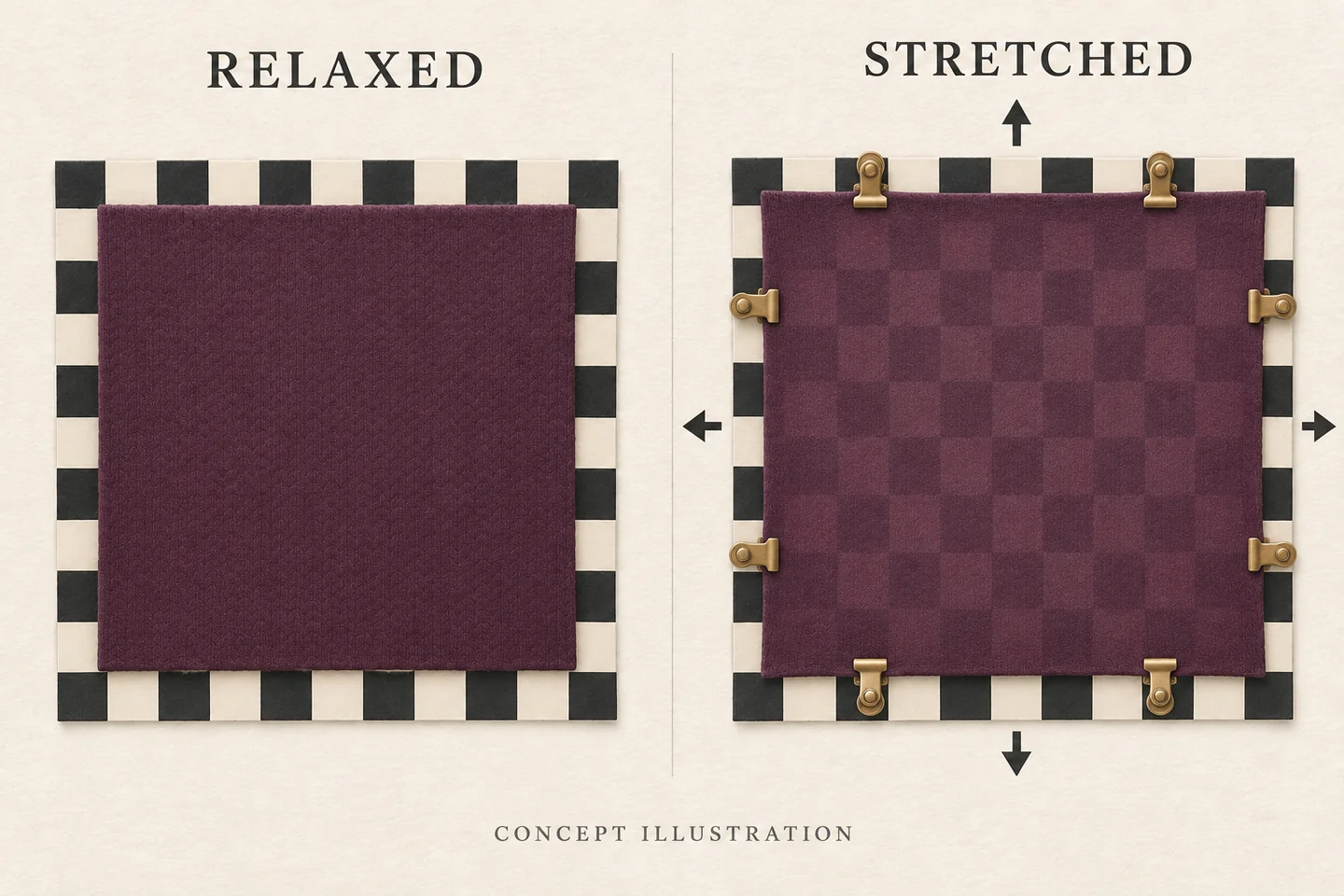
AI-generated concept illustration showing how a contrasting pattern can become more visible through stretched fabric.
A pair of leggings can look opaque while you're standing, then reveal the colour or outline underneath as you lower into a squat.
Leggings can become see-through during a squat because stretching changes the shape of the knitted loops and can open the spaces between yarns. More light may then pass through the fabric. Coverage therefore needs to be checked at the stretch levels the garment will reach during wear. Zhang et al., Textile Research Journal, 2023
Highlights
- Coverage can change as fabric stretches. Check a swatch at the stretch it will reach in the garment.
- Stretch direction matters too. Pulling in one direction and stretching in two directions can produce different results.
- Consider fabric, colour and fit together. Compare swatches under consistent conditions, then check coverage in the finished garment during movement.
What happens to light when knit fabric stretches?
Light can pass through the spaces between yarns and through the yarns themselves. As a knit fabric stretches, its loops change shape. Spreading the fabric over a larger area can open up those spaces and let more light through. Yazaki et al., Sen'i Gakkaishi, 2005
A 2023 study compared three plain-knit fabrics for seamless sportswear under different stretching conditions. In the samples tested, light transmission increased as the fabrics stretched further. Stretching in both directions, known as biaxial stretching, produced the highest light transmission. Zhang et al., Textile Research Journal, 2023
Why does stretch direction matter?
When you pull a swatch sideways, it gets wider and may also shorten in the other direction. In a close-fitting garment, the body and the cut of the garment constrain how the fabric can move.
Researchers at Shinshu University found that their plain-knit samples transmitted different amounts of light when stretched lengthwise and widthwise, even at the same percentage extension. That gives a practical reason to record both how far a fabric is stretched and in which direction when comparing coverage. Yazaki et al., 2005
Start with swatches stretched by a consistent amount in clearly defined directions. Then try the garment in its intended size and fit, watching the areas that stretch further during squats and forward bends. This connects what you see in a fabric sample with what happens during wear.
How should you check fabric for squat-proof leggings?
Keep the comparison conditions consistent. A pale background, a dark background and a strongly contrasting pattern can each reveal different details through the same fabric. Use the same background, lighting and degree of stretch when comparing candidate fabrics.
Hohenstein's Opaqueness and Opacity factsheet describes an opaqueness assessment using defined skin tones and contrasting backgrounds. It also allows conditions such as stretched, wet or washed samples to be agreed according to the intended use. Hohenstein, 2020
For fabric development, a practical comparison can cover four stages:
| Stage | What to compare |
|---|---|
| Fabric swatches | Use the same background, lighting, stretch direction and amount of stretch. Record the dimensions before and after stretching. |
| Garment fit | Check coverage in the intended size and fit while standing, squatting and bending forward. |
| Colour approval | Compare the actual colours planned for the range under the same conditions. |
| After laundering | Follow the agreed washing and drying procedure, then repeat the comparison under the same conditions. |
How far a fabric stretches and how well it covers at that stretch are two separate things to check. Our yoga leggings fabric testing guide explains how to consider coverage alongside stretch, recovery and wash stability.
When discussing a fabric brief with FJORATEX, include the intended fit, size range, colours and activities. Those details make it easier to agree how the fabric's coverage should be assessed.
Next Step
Ready to develop your next fabric?
Share your reference or requirements. We can discuss fabric options and how to take the project forward.
Get in touch