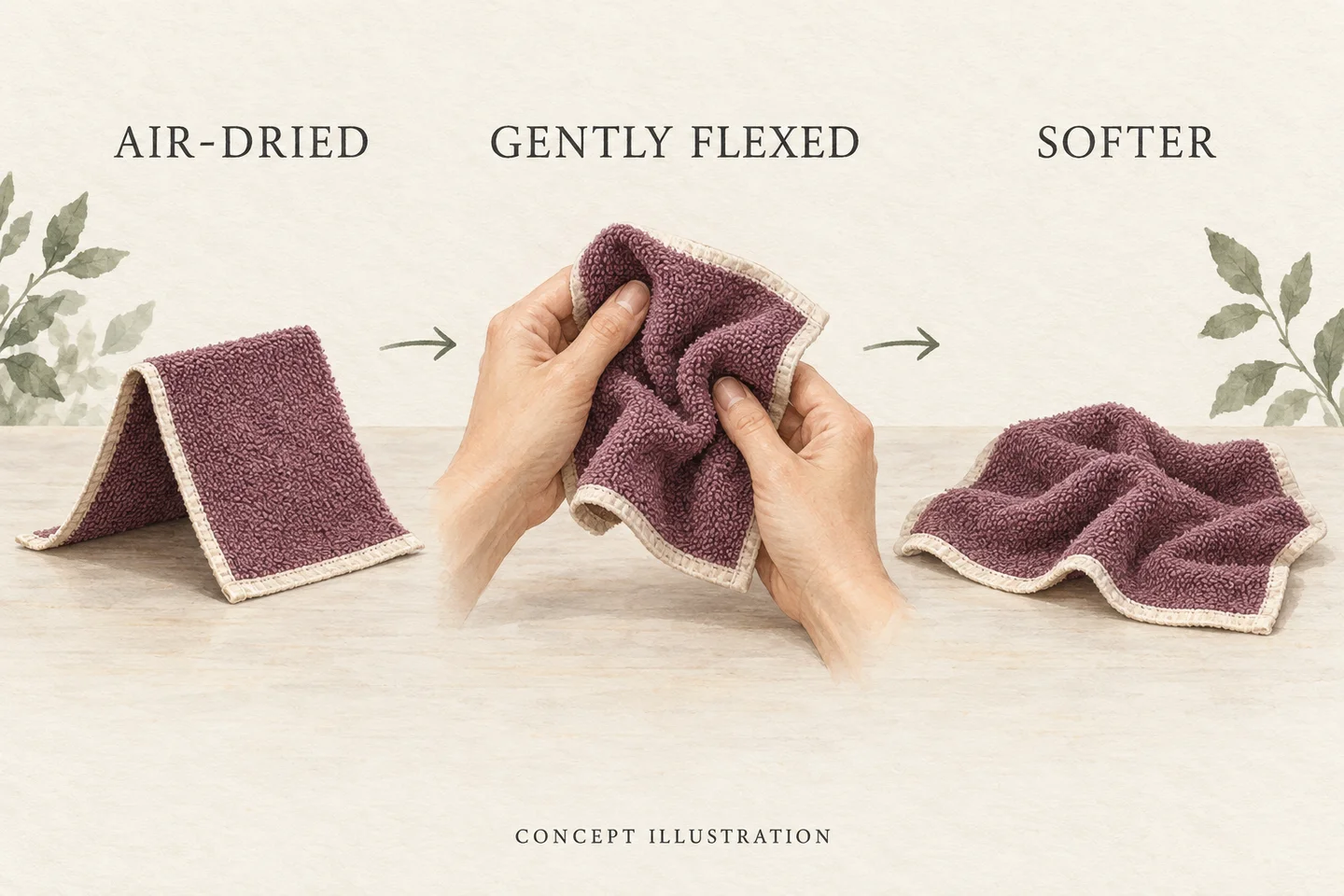
AI-generated concept illustration showing air-dried cotton becoming more pliable after gentle flexing.
A cotton towel can feel almost starched after washing and air-drying. Give it a few gentle bends and squeezes, and it often feels more supple.
Cotton can feel stiff after air-drying because bound water helps form links between neighbouring fibres. These links restrict how freely the fibres move. Bending or gently scrunching the fabric can break some of them, allowing the fibres to move more easily and the fabric to bend with less resistance. Igarashi et al., Journal of Surfactants and Detergents, 2016
Highlights
- Cotton can feel dry and still hold bound water. This water can help neighbouring fibres adhere to one another.
- Handling can change how cotton feels. Gentle flexing can loosen some of those connections.
- Compare swatches in the same condition. Record how they were dried, stored and handled.
How can water matter if the cotton feels dry?
Cotton is made mainly of cellulose, which has a strong affinity for water. After air-drying, some water can remain closely bound to the fibre surface. This is known as bound water. Kao, 2020
When fibres sit close together, thin layers of water between their surfaces can create capillary adhesion. These tiny connections hold the fibres together, making a yarn bundle harder to bend.
In 2020, researchers at Kao and Hokkaido University observed bound water on cotton surfaces using atomic force microscopy and infrared spectroscopy. Their findings supported this explanation for why cotton hardens during natural drying. Hokkaido University research summary
What changes when you bend or scrunch the fabric?
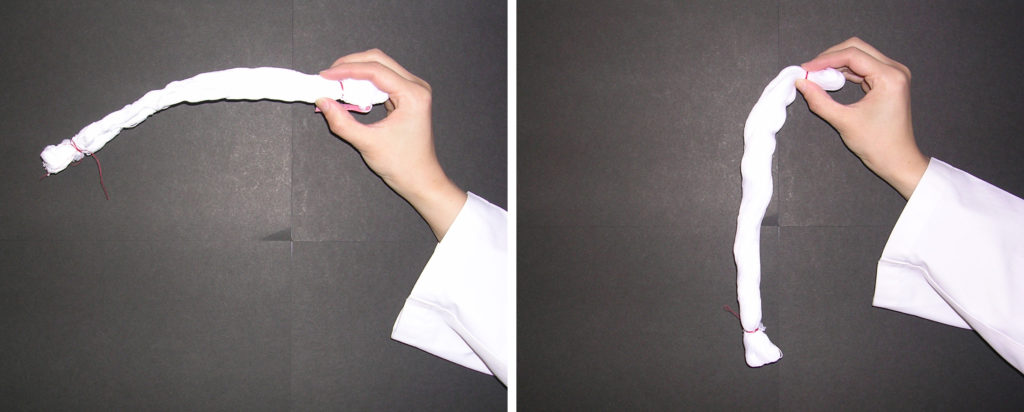
Igarashi and colleagues measured this effect in repeated bending tests. In the cotton samples they tested, resistance fell between the first and second bends. They linked the change to disruption of the hydrogen-bonded network between fibres. Igarashi et al., 2016
The fibre content stays the same, but the connections between fibres change. That helps explain why a freshly dried swatch may feel different after a few bends.
How should you compare the softness of cotton fabrics?
If one swatch has just dried and another has been repeatedly handled, their starting conditions differ. That difference can influence your judgement of softness.
When comparing cotton or cotton-blend fabrics, note how they feel after washing and drying, alongside fabric weight and thickness. Then gently flex each sample in the same way and compare them again. Keep washing, drying and storage conditions consistent.
Agree on the condition of the samples before deciding which one feels softer.
If softness after washing is part of your brief, share the reference fabric and intended care routine when discussing development with FJORATEX. Include those conditions in your assessment record so the next set of samples can be compared in the same way.
Next Step
Ready to develop your next fabric?
Share your reference or requirements. We can discuss fabric options and how to take the project forward.
Get in touch