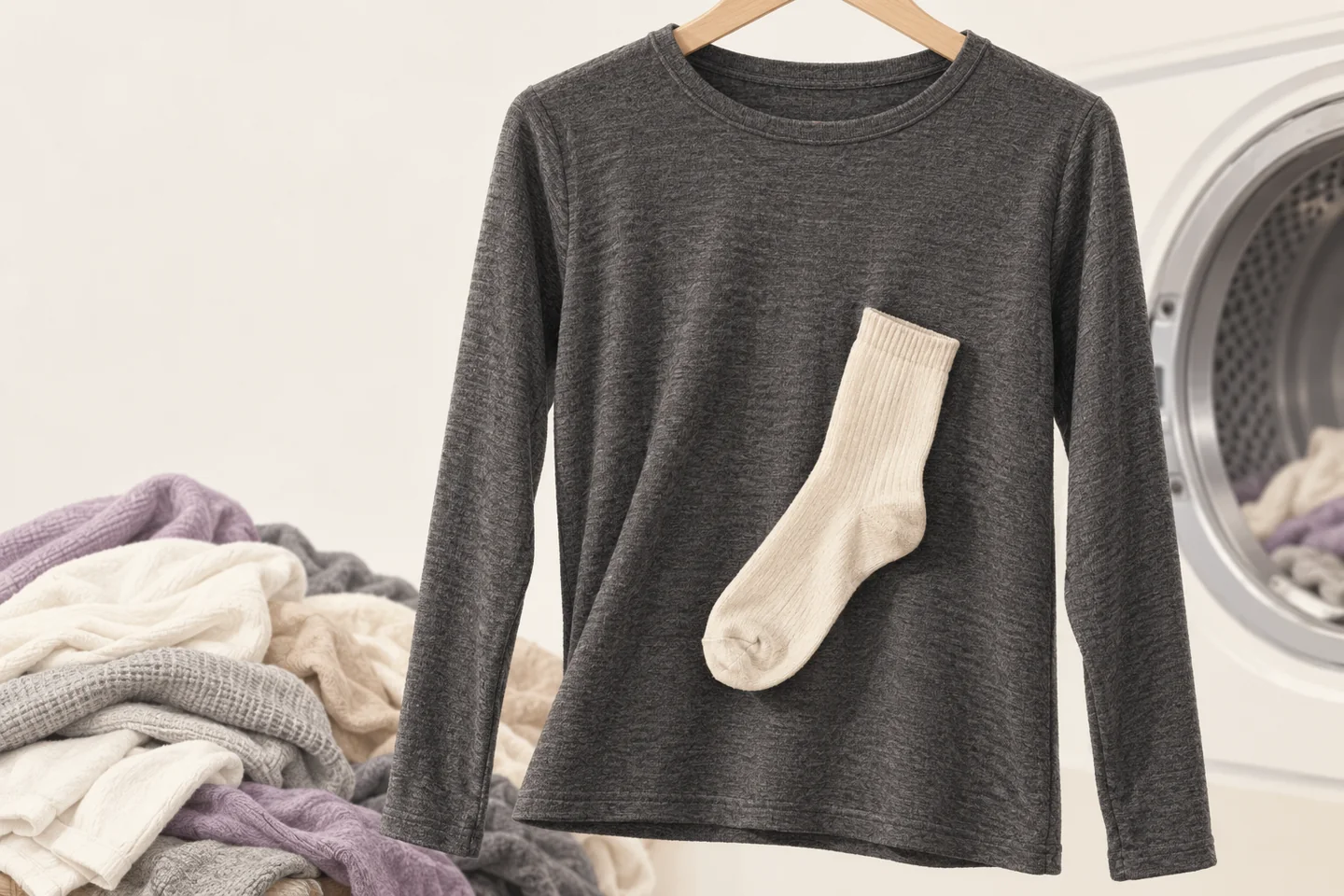
AI-generated scene illustrating a sock clinging to a top.
A top crackles as you take it off. Your hair stands up, or a skirt keeps clinging to your legs no matter how often you smooth it down.
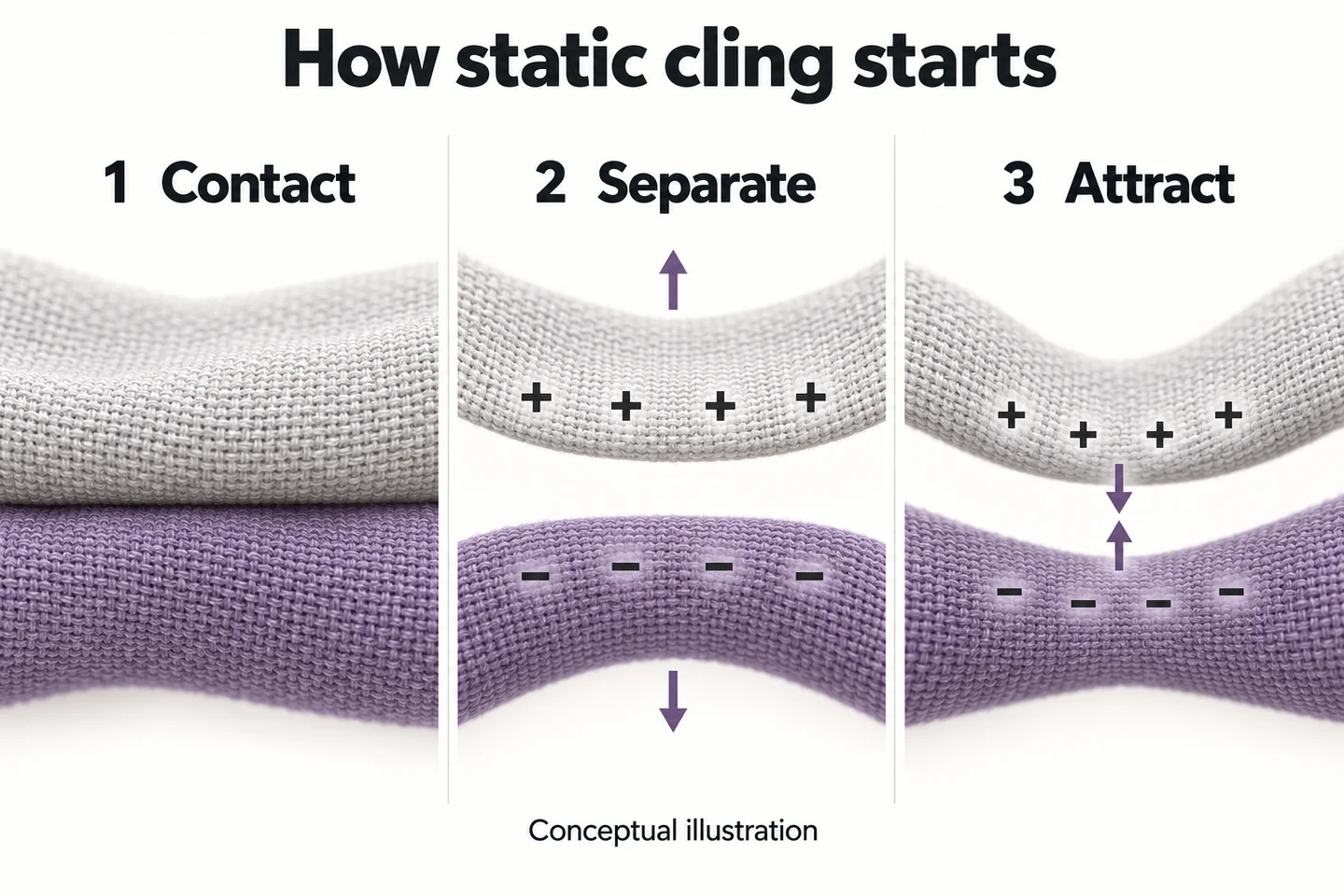
Clothes develop static when contact and separation transfer electrical charge that cannot dissipate quickly enough. This can happen repeatedly as fabrics rub together. Electrostatic attraction can make clothes cling to the body or to each other, while a rapid discharge can produce a crackle or a small spark. EOS/ESD Association: ESD Fundamentals
The same garment may feel fine one day and cling the next. Humidity, the layer underneath and recent washing and drying can all make a difference.
Highlights
- Dry conditions make static more likely. With less moisture on a material’s surface, charge often has more difficulty dissipating.
- The other fabric matters, too. When choosing fabrics for layered clothing, include the garments they will be worn with in the comparison.
- Overdrying can make static worse. Once clothes are dry, continued tumbling adds friction and removes more residual moisture.
Why is static cling worse in winter?
The dry conditions often found in autumn and winter affect how quickly charge can dissipate.
Many materials pick up a very thin layer of moisture on their surfaces from the surrounding air. This moisture can provide a path for charge to dissipate. As humidity falls and surface moisture decreases, charge may have more difficulty escaping. EOS/ESD Association: Understanding ESD Control
As you dress and move, fabrics keep touching and separating. When charge is transferred faster than it can dissipate, it accumulates. That helps explain why the same garment can cling to an inner layer or crackle when taken off in a dry room.
Why does the layer underneath matter?
A jacket repeatedly brushes against the layer underneath. Change that layer, and you change the material it touches, which can affect how charge transfers and builds up.
A 2000 study compared fabric cling under different humidity and charging conditions. Alongside the test fabric’s fibre content and moisture level, the fibre composition of the material rubbed against it also affected the results. Andrassy et al., Tekstil, 2000
So, when assessing how readily a garment develops static cling, consider what it will be worn with. For layered clothing, the fabric combination itself is worth comparing.
Why do clothes cling together after tumble drying?
During tumble drying, clothes lose moisture while repeatedly touching and separating as they turn in the drum.
A 2007 study using cotton, nylon and polyester fabrics found that longer drying times reduced moisture content and increased static charge. In these experiments, drying mixed fabric types also produced more static than drying a single type. Park et al., Fibers and Polymers, 2007
Keeping clothes in the dryer after they are dry can make static worse. For garments that can be tumble dried, choose a suitable programme and avoid adding extra time once the clothes are dry.
How can you check for static cling when choosing fabrics?
When choosing wool-blend base layers, linings or midlayers, start with the clothes they will be worn alongside. Put together one outfit, then change just one layer at a time. Compare how much the garments cling as you move, put them on and take them off. This makes it easier to see which change affects comfort.
Keep the environment and care conditions as consistent as possible. For autumn and winter clothing, repeat the comparison in a dry environment. If performance after laundering matters, record the washing and drying methods and the number of cycles used.
For laboratory comparisons, ask about AATCC TM115, Electrostatic Clinging of Fabrics: Fabric-to-Metal Test. It evaluates the relative tendency of fabrics to cling because of static charge, incorporating the effects of fabric weight, stiffness, construction and finishing. AATCC TM115: official scope
Our guide to reading knit fabric test reports explains what to check about test methods and conditions. When discussing fabric development with FJORATEX, include the intended inner layer, season and care requirements so that sample comparisons and testing can reflect how the garment will be worn.
Next Step
Ready to develop your next fabric?
Share your reference or requirements. We can discuss fabric options and how to take the project forward.
Get in touch