Why Some Fabrics Feel Cooler Than Others, and Why It's Not Just About Wicking Speed
July 6, 2026
Key Takeaways
- The cooling you feel from a fabric comes from evaporation pulling latent heat off your skin — but when that evaporation happens matters as much as how much of it happens.
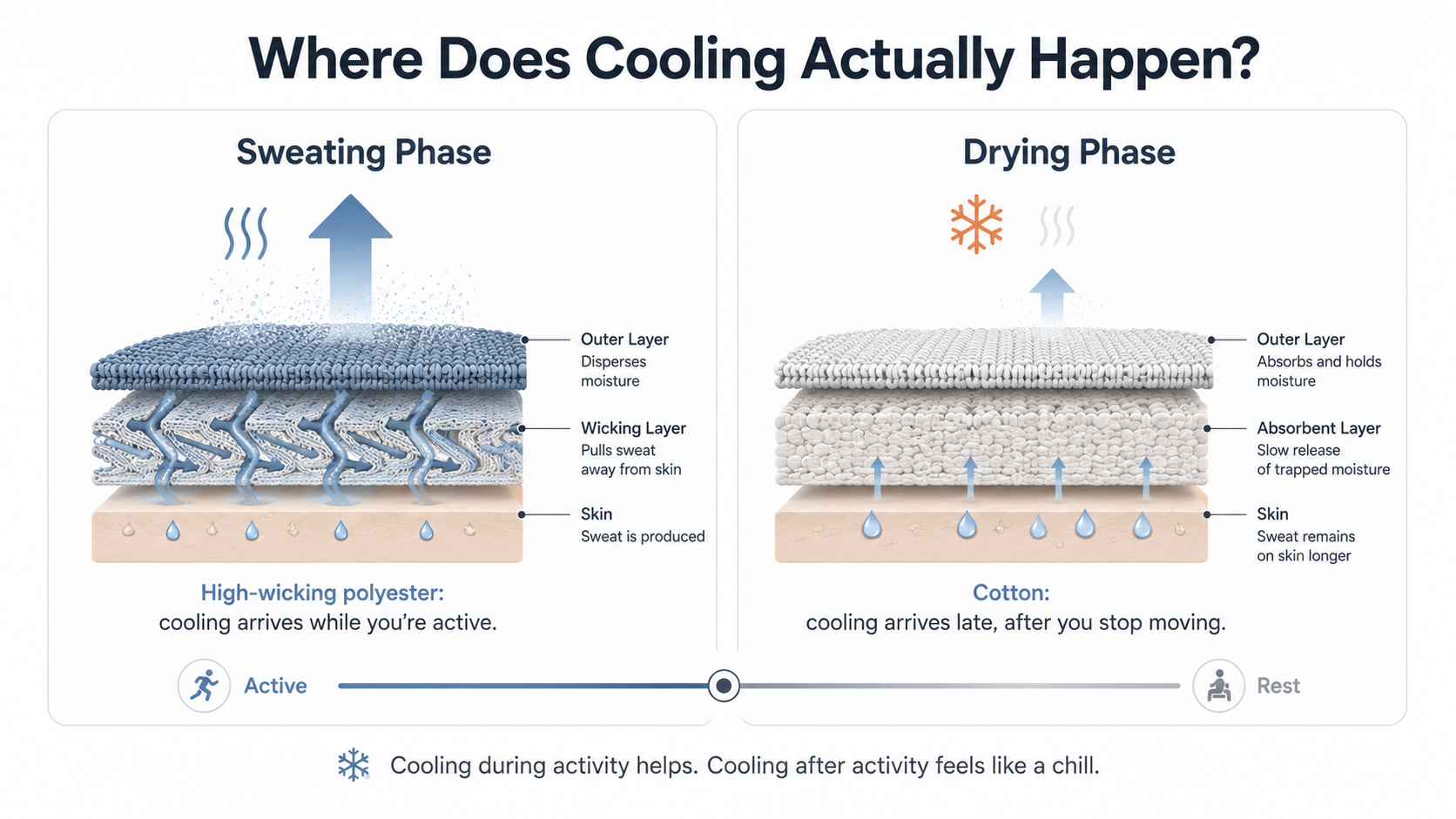
- Research using a dynamic sweating hot plate found that high-wicking polyester delivers most of its cooling during the sweating phase, when the body is active and needs it.
- Cotton delivers more of its cooling during the drying phase, after activity stops, which is the mechanism behind post-exercise chill.
- Standard lab tests measure a fabric's steady-state heat-loss capacity, not the timing of cooling, so two fabrics with similar test numbers can feel very different in use.
- Fabric selection for cooling should account for cooling timing, not wicking speed or total evaporation alone.
Ask two people why one shirt feels cooler than another and you will usually hear the same answer: it wicks faster. Wicking matters, but it doesn't fully explain the sensation of cooling. A fabric can move sweat quickly and still leave the wearer feeling clammy, or leave them chilled after they stop moving. Research from the Textile Protection and Comfort Center at NC State University points to a more useful way of thinking about the problem — one built around when a fabric delivers its cooling, not just how much moisture it handles.
What "Cooling" Actually Means in a Fabric
The cooling a wearer feels is driven by latent heat of evaporation. When sweat evaporates, it absorbs heat, and if that evaporation happens at or near the skin, the heat comes from the body. The faster and more effectively a fabric supports evaporation close to the skin, the more cooling the wearer perceives.
This is distinct from wicking. Wicking describes how liquid moisture moves through and spreads across a fabric. Evaporation is what removes heat. A fabric can be good at one and unremarkable at the other, which is why wicking speed alone is a poor proxy for how cool a garment feels.
The Limitation of Standard Cooling Tests
Common laboratory methods — such as total heat loss and evaporative resistance — evaluate a fabric while it is fully saturated and held in a steady state. They tell you how much heat a fabric can shed once it is completely wet, under fixed conditions.
Real wear does not work that way. A person sweats, the fabric takes on moisture, and then, when activity slows, the fabric dries. That is a cycle with distinct phases, and the amount of cooling a fabric provides is not constant across it. A steady-state number cannot capture that, which means two fabrics can post similar test results and still behave differently on the body.
A Test Built Around the Sweat-and-Dry Cycle
To close that gap, the NC State researchers developed a dynamic sweating hot plate. Instead of holding the fabric in a saturated steady state, the apparatus simulates the full cycle a garment experiences: a sweating phase, where moisture is introduced as it would be during activity, followed by a drying phase, where moisture supply stops and the fabric dries out.
Throughout both phases, the plate continuously measures how much latent heat the fabric captures. Because latent heat is the mechanism of evaporative cooling, this measures cooling directly rather than inferring it from steady-state heat-loss capacity. The method also makes wicking and moisture-spreading behavior visible in real time, which makes it useful for evaluating activewear fabric more broadly, not only for cooling.
Why Polyester and Cotton Cool Differently
The comparison that makes the point clearest is high-wicking polyester against cotton.
| Fabric | Where most cooling occurs | Practical effect |
|---|---|---|
| High-wicking polyester | Sweating phase (during activity) | Cooling arrives when the body is working and needs it |
| Cotton | Drying phase (after activity stops) | Cooling arrives late, contributing to post-exercise chill |
High-wicking polyester absorbed more latent heat during the sweating phase. In practical terms, it provides its evaporative cooling while the wearer is active — the moment cooling is most useful.
Cotton absorbed more latent heat during the drying phase, after sweating had stopped. That delayed cooling is the mechanism behind post-exercise chill, the clammy, cold feeling that sets in once a person stops moving. The cooling is real, but it lands at the wrong time, and the wearer experiences it as discomfort rather than relief.
Why Timing Changes How You Read a Fabric
The takeaway is that total evaporation is not the whole story. Two fabrics could remove a similar amount of heat overall and still feel very different, because one front-loads its cooling into the active phase and the other back-loads it into the drying phase. Cooling during activity is a benefit. Cooling after activity is often a burden.
This reframes the design question. Rather than asking which fabric evaporates the most moisture, it is more precise to ask when a fabric releases its cooling relative to what the wearer is doing. For most performance apparel, the goal is strong cooling during exertion and a controlled, gradual return to baseline afterward — not a delayed cold spike.
How FJORATEX Can Support This
FJORATEX develops and sources moisture-management performance knits, and this line of research shapes how we think about fiber and structure choices when cooling behavior matters. We have not run these specific hot-plate tests on our own fabrics, so we don't claim to have reproduced these results in-house. What the work does inform is the framing we bring to development: that cooling timing, not wicking speed alone, is worth considering when a fabric is meant to keep a wearer comfortable during and after activity.
When a program calls for cooling performance, we can help evaluate fiber selection and knit construction against how the fabric is actually meant to be worn, and route candidate fabrics to appropriate testing so decisions rest on measured behavior rather than assumption.
Research source: Gao, Deaton, and Barker, "A new test method for evaluating the evaporative cooling efficiency of fabrics using a dynamic sweating hot plate," Measurement Science and Technology, 2022.
Next Step
Ready to develop your next fabric?
Share your brief and we'll respond within one business day to discuss technical fit, timing, and next steps.
Initiate a Project