Key Takeaways
- A common assumption is that water-repellent (DWR) finishing seals a fabric and traps heat. The most direct study on this question found that assumption did not hold when DWR was applied to an inner layer rather than the outer face.
- In controlled tests, adding DWR to a thermal liner made no significant difference to heat-loss capacity at either the fabric level or the finished-garment level.
- The DWR-treated fabric also absorbed significantly less moisture, meaning it stayed drier and lighter during use — a comfort gain, not a penalty.
- Important caveat: this study was run on firefighter turnout gear, not on activewear. The finishing science is the same, but the findings are suggestive for lighter performance apparel, not proven on it.
- PFAS-free DWR generally repels water only (not oil), which matters for spec choices as the industry moves away from PFAS chemistry.
Water-repellent finishing sits on the outer surface of most performance garments, and a persistent worry follows it: if a fabric is treated to keep water out, does it also keep heat and moisture vapor in? For anyone developing base layers, mid-layers, or shells, this is a real question, because breathability is often the whole point of the garment. The short answer from the available research is more reassuring than the assumption — but where the finish is placed matters, and the strongest evidence comes from a context more extreme than activewear.
What DWR Finishing Actually Does
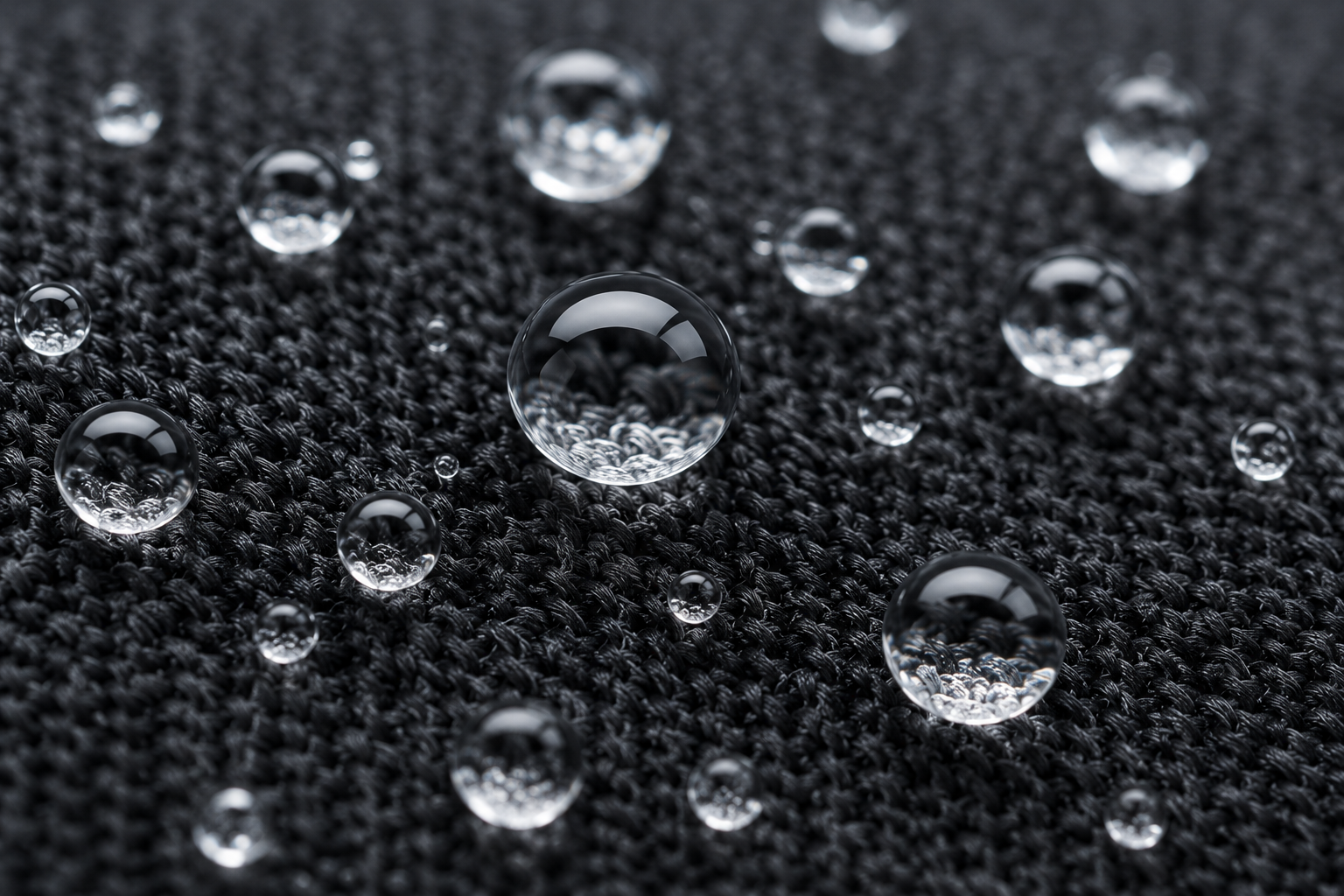
DWR stands for durable water-repellent finishing. It is a surface treatment that lowers the fabric's surface energy so that water beads up and rolls off rather than soaking in. It is not a waterproof membrane; it does not fully block airflow. The concern about breathability comes from the idea that any surface treatment might partially occupy the spaces between yarns and slow the movement of heat and moisture vapor through the fabric.
DWR chemistry comes in two broad families. PFAS-based finishes repel both water and oil and have been the industry standard for durability, but they carry well-documented environmental and health concerns. PFAS-free finishes generally repel water only, not oil, and are now the direction most of the industry is moving. That distinction matters when you spec a garment: a PFAS-free finish will shed water but will not resist oily stains the way a legacy fluorinated finish did.
What the Research Tested
The clearest study on the heat question comes from researchers at the Fashion Institute of Technology and the Textile Protection and Comfort Center at NC State University, published in the AATCC Journal of Research in 2024. It is important to be precise about what they studied: firefighter turnout gear, not activewear.
Turnout gear normally carries DWR on its outer shell. Some earlier work had suggested that this outer-shell finish could reduce a garment's ability to release heat. The researchers asked a different question that no one had tested directly — what happens if the DWR is applied instead to the thermal liner, the inner insulating layer, rather than the outer shell?
To answer it, they measured the same fabrics and garments three ways: a sweating hot plate for fabric-level heat-loss capacity, a sweating manikin for garment-level heat loss, and a physiological manikin to simulate the body's response. Each comparison was run with and without DWR on the thermal liner.
What They Found
The results ran against the common assumption:
| Measure | Effect of DWR on the thermal liner |
|---|---|
| Fabric-level heat-loss capacity | No significant difference |
| Garment-level heat-loss capacity | No significant difference |
| Simulated physiological response (moderate conditions) | No significant difference |
| Moisture absorbed during testing | Significantly lower with DWR |
In plain terms: adding a water-repellent finish to the inner layer did not meaningfully hurt the garment's ability to shed heat. On top of that, the treated garments absorbed less moisture, so they stayed drier and picked up less sweat and water weight over the course of testing. That is a comfort improvement, not a cost.
The authors are careful about scope, and so are we. This was an initial finding under moderate environmental conditions, and they note it needs further testing across a wider range of conditions before it can be treated as settled.
What This Does and Does Not Tell Activewear Developers
This is where honesty matters more than a clean marketing line. The study was on protective clothing — heavy, multi-layer firefighter gear under thermal stress. Activewear is lighter, usually single-layer or two-layer, and worn in far less extreme conditions. The finishing science is the same, and the direction of the finding is useful: a water-repellent surface treatment did not, in this case, act like a heat trap, and it reduced moisture pickup.
But the direction of a finding is not the same as a measured result on your fabric. These tests were not run on knit activewear, and no one should present them as if they were. What they reasonably support is a more skeptical stance toward the blanket claim that DWR always kills breathability. What they do not support is a specific breathability number for a jersey base layer. If breathability is critical to a program, it still needs to be tested on the actual construction.
How FJORATEX Can Support This
FJORATEX does not have its own lab data confirming these specific results on its own fabrics, and we will not claim otherwise. What this research does is shape how we think about finishing decisions — particularly where a water-repellent finish sits in a construction and how PFAS-free chemistry behaves compared to legacy finishes. When a program calls for water repellency alongside breathability, we treat that as a tradeoff to brief and test explicitly, not to assume away. We can help specify PFAS-free DWR options, flag where oil repellency will be lost in the switch, and route the finished construction to appropriate breathability testing so the decision rests on data from your fabric, not a borrowed result.
Research source: Gao, Deaton, and Barker, "Impact of Durable Water-Repellent Finishing in Thermal Liner on Firefighter Heat Stress," AATCC Journal of Research, 2024.
Next Step
Ready to develop your next fabric?
Share your brief and we'll respond within one business day to discuss technical fit, timing, and next steps.
Initiate a Project