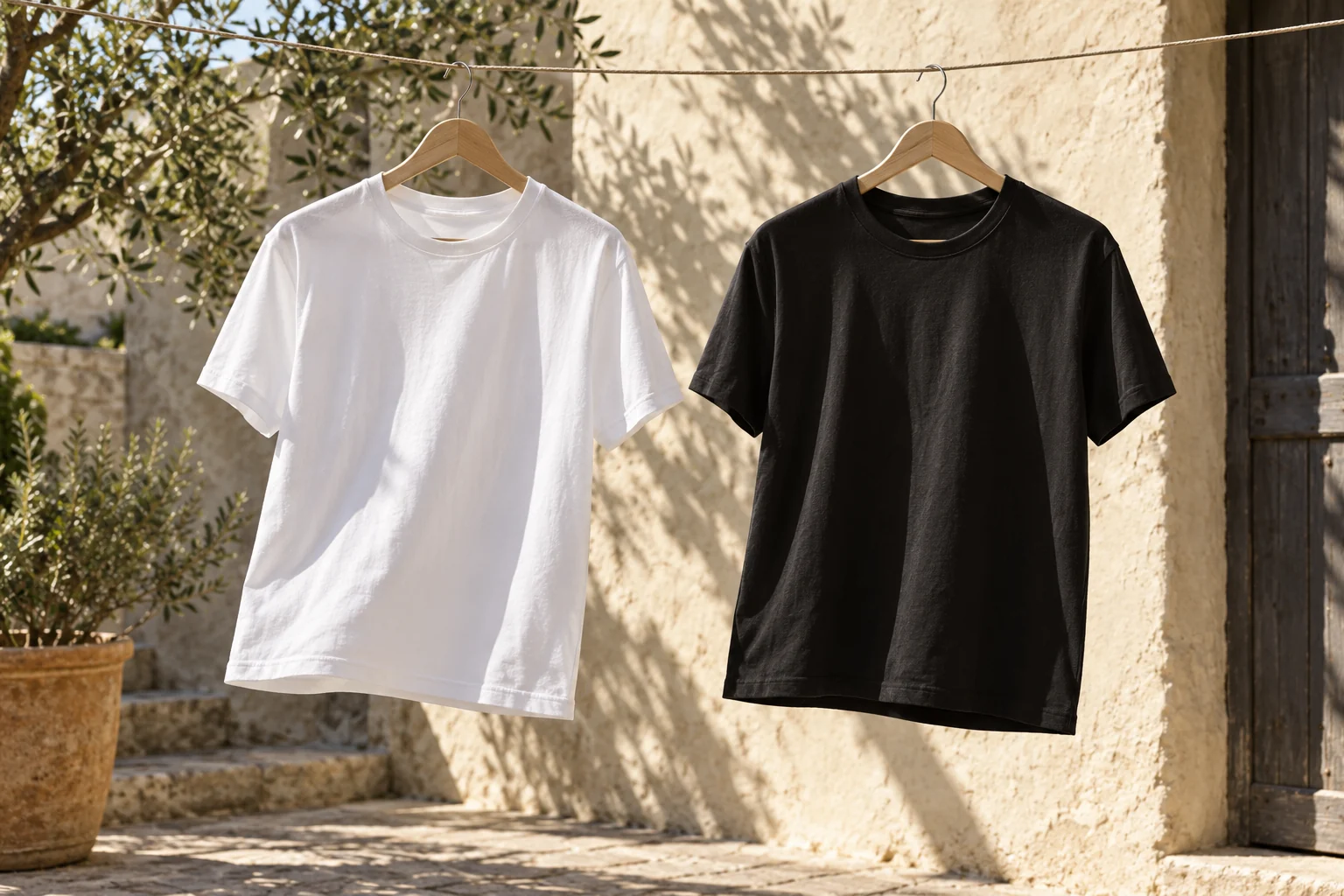
Black and white knit T-shirts in a sunny courtyard. AI-generated editorial image created for FJORATEX.
White clothes seem like the obvious choice for a hot, sunny day. Black absorbs more sunlight, after all. So why would anyone wear a black robe in the desert?
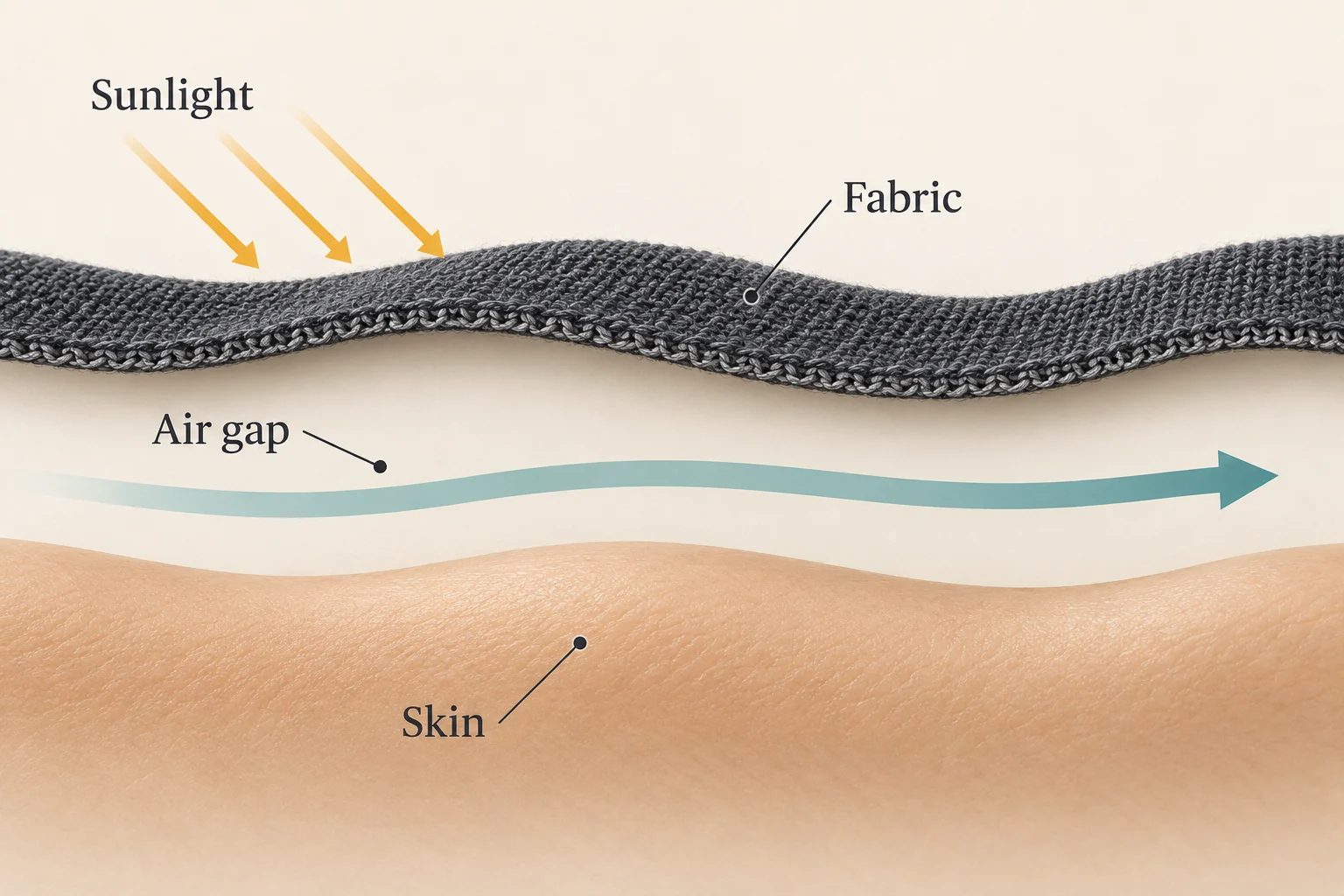
Black clothing usually absorbs more solar energy and gets hotter at the surface than comparable white clothing in the same sunlight. How hot the wearer gets also depends on heat transfer through the fabric, the air gap next to the skin and ventilation through the garment.
Highlights
- Black fabric usually heats up more in direct sun. Colour affects how much solar energy a fabric absorbs and reflects.
- Heat absorbed by clothing still has to reach the skin. The fabric, air gap and ventilation all influence that transfer.
- Compare summer fabrics in the colours and fit you intend to use. Surface temperature, conditions inside the garment and wearer feedback answer different questions.
Do black clothes absorb more heat than white clothes?
When sunlight reaches a fabric, some is reflected, some is absorbed and some may pass through. The absorbed energy warms the material. Ordinary black fabrics tend to absorb more solar energy, while white fabrics generally reflect more of it. National Institute for Environmental Studies, Japan
In a study published in 2024, Ichinose and colleagues compared polo shirts made from the same material, in the same design, but in different colours. In clear weather with little wind, the maximum surface-temperature difference between black or dark green shirts and white shirts exceeded 15°C. Ichinose et al., 2024
The researchers paired ordinary photographs with thermal images to show how the fabric surfaces warmed. These can be seen in Figure 1 of the openly licensed preprint.
Near-infrared reflectance matters too. Sunlight includes near-infrared radiation that our eyes cannot see. The same study found that reflection in this part of the spectrum also helped explain surface temperatures. For colours such as red and green, visible darkness alone did not tell the whole story. Ichinose et al., 2024
Why do Bedouins wear black robes in the desert?
A 1980 study in Nature examined this question by comparing black and white Bedouin robes in desert conditions. The researchers reported the same heat gain in a wearer dressed in either colour. The extra energy absorbed by the black robe dissipated before reaching the skin. Shkolnik et al., 1980
The space inside a garment matters here. Air between fabric and skin affects insulation, while garment openings provide routes for air exchange. A top that sits against the skin creates different conditions for heat transfer from a loose top with room for air to move.
A 2025 study using heated plates and a heated torso found that air-gap thickness, wind speed and ventilation interacted in determining heat transfer through layered fabric systems. Garcia Torres et al., 2025
Colour affects how much sunlight the cloth absorbs; garment construction helps determine where that heat goes.
How should you compare fabrics for summer clothing?
Three things are worth bringing into the comparison.
Start with the actual colours. To examine the effect of colour, keep fibre composition, knit structure, fabric weight and finishing as consistent as possible. Include the dark and light shades planned for the collection.
Make samples in the intended fit. A fitted training top and a loose everyday shirt have different air gaps and openings. Once the fabric is shortlisted, compare garment samples under similar sunlight, wind and activity conditions to see how material and construction work together.
Keep the observations distinct. Thermal imaging shows surface temperature. Temperature and humidity inside the garment describe the environment next to the body. Wearer feedback captures how hot or stuffy the garment feels. Initial cool-to-touch sensation can be assessed separately, with the conditions for each comparison recorded in the test report.
For a summer knit project with FJORATEX, bring the intended colours, garment fit and use conditions into the brief. Those details make it easier to decide what to sample and compare.
Next Step
Ready to develop your next fabric?
Share your reference or requirements. We can discuss fabric options and how to take the project forward.
Get in touch