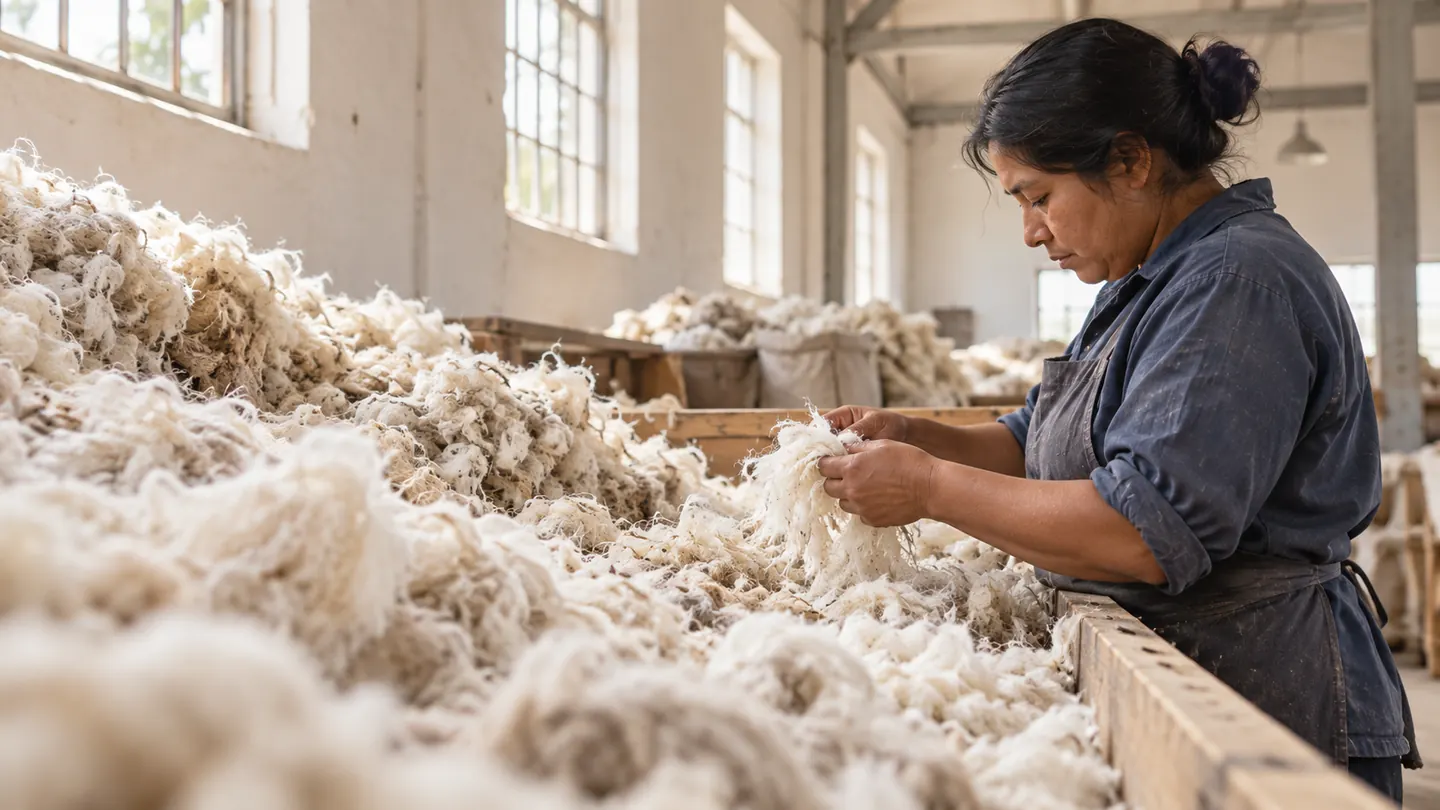
AI-generated editorial illustration of fibre sorting, based on a reference photograph.
Reviewed 30 September 2026.
The EU’s Empowering Consumers for the Green Transition Directive changes how businesses can present environmental claims to consumers. For apparel buyers, a practical consequence is that information about a yarn or fabric must remain specific when it becomes a claim about a finished garment. A material attribute cannot automatically justify a broader environmental promise.
Member States must apply the measures under Directive (EU) 2024/825 from 27 September 2026. This article focuses on the implications for fabric sourcing, rather than a full review of consumer law. European Commission
What changes for clothing claims?
Three restrictions are particularly relevant:
- Generic environmental claims: broad descriptions such as “eco-friendly” are prohibited where the trader cannot demonstrate recognised excellent environmental performance relevant to the claim. An ordinary supplier declaration is not equivalent to that legal standard.
- Sustainability labels: these must be based on a qualifying certification scheme or established by public authorities. A brand-created green badge cannot simply stand in for that basis.
- Whole-product claims: an environmental claim about an entire product is prohibited when it concerns only a particular aspect of that product.
These are distinct requirements. They should not be reduced to a blanket statement that every environmental claim needs third-party certification. Specific factual claims still need to be accurate and must not mislead. Directive (EU) 2024/825, recitals 7–11 and Annex
How does this affect a fabric description?
Consider a hypothetical jacket whose main fabric contains 50% recycled polyester by mass. That figure describes the main fabric. It does not establish the recycled content of the lining, insulation or complete jacket, and it does not establish the jacket’s overall environmental impact.
For review, start with wording that identifies the component and the measured attribute: “The main fabric contains 50% recycled polyester by mass.” This is an illustration of scope, not a pre-approved legal claim. The percentage, supporting evidence and overall presentation still need checking. The prohibition on turning an aspect into a whole-product claim makes this distinction important. Council of the EU
What should buyers request from a fabric supplier?
Use the intended claim to identify the information needed:
| Check | Practical question |
|---|---|
| Material identity | Do the documents match the fabric reference and current composition being ordered? |
| Calculation basis | Does the percentage describe a yarn, the finished fabric or the whole garment? |
| Certification scope | What entity, product or process does the certificate cover, and is the intended label use permitted? |
| Connection to the order | What records connect the claimed material to this supply? |
| Development changes | If the yarn, supplier or composition changes, which supporting documents need reviewing? |
This is a suggested sourcing review, not a universal document list imposed by the directive. Different claims need different evidence. The same attention to sample identity is useful when reading a knit fabric test report.
When should this enter the development process?
Include the intended material claim in the brief while fabric options are still being compared. If the evidence does not support it, the team can narrow the claim or reconsider the material before production. Keep the approved specification and supporting records together so later changes are visible to whoever prepares the product description.
For a knit fabric development and sourcing partner such as FJORATEX, this belongs alongside the practical details of the development process: agree what is being supplied and keep the information tied to that material.
Next Step
Ready to develop your next fabric?
Share your brief and we'll respond within one business day to discuss technical fit, timing, and next steps.
Initiate a Project