Engineering Merino Wool for Performance: How Blends Work and Why They Matter
June 21, 2026
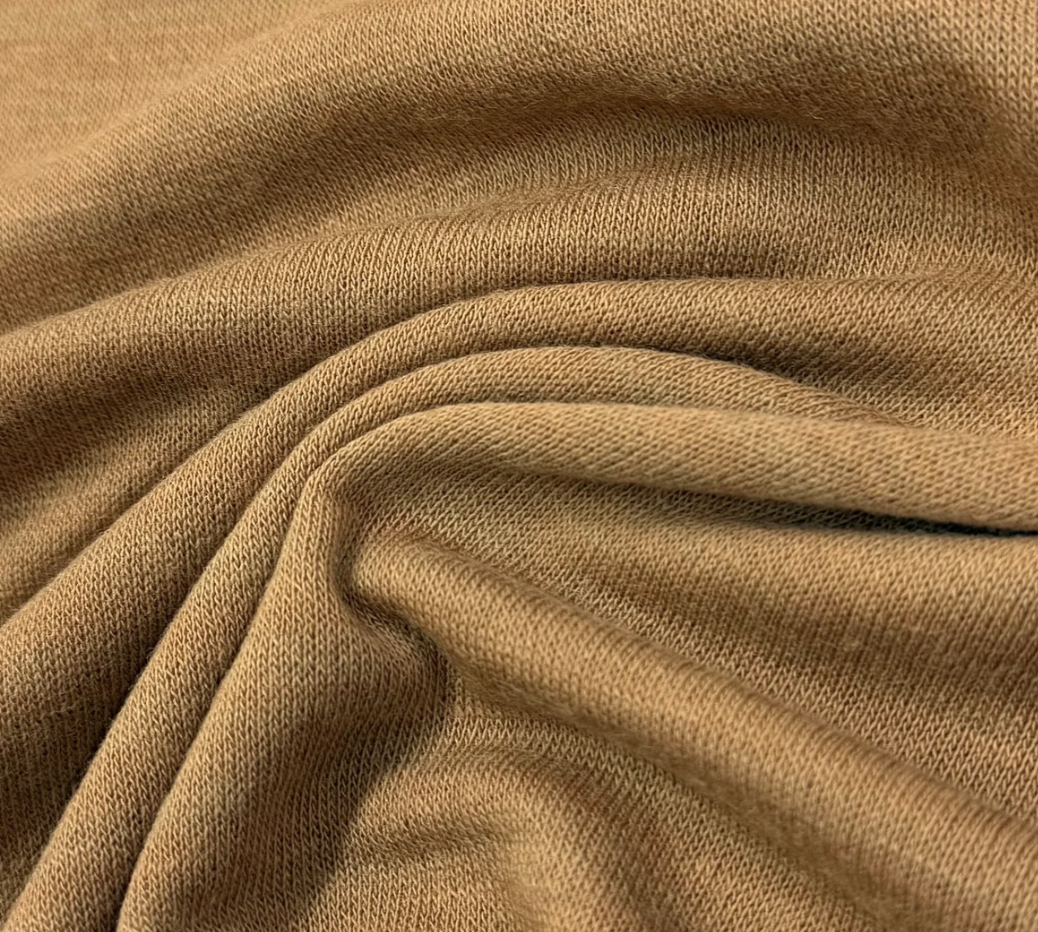
180g extra-fine merino wool jersey — plain construction, camel colorway. The surface shows the fine, uniform stitch quality characteristic of 110s worsted yarn at 28G gauge.
Merino wool is one of the few natural fibers that holds a genuine place in performance apparel — not because of marketing, but because its physical properties address real problems in activewear: moisture accumulation, odor buildup, and the tradeoff between insulation and breathability. However, understanding how merino functions as a base material is only part of the picture. How it is blended, processed, and constructed into a finished knit fabric determines whether a garment performs well across a product's actual lifetime.
This guide is intended for apparel brands, product developers, and sourcing teams approaching merino performance fabric development — whether for a first base layer, a running top, or a multisport garment that needs to travel well.
Why Merino Works in Performance Applications
The performance properties of merino wool are structural, not applied treatments that wash out over time.
Moisture management: Merino fiber can absorb moisture vapor into its fiber core at rates up to 35% of its own weight before the hand feel registers as wet. This matters in activewear because it means the fabric continues to manage moisture without producing the damp, clingy sensation that synthetic fabrics generate when sweat volume is low or moderate. In high-sweat, high-intensity conditions, synthetic fabrics with surface wicking may outperform merino — but in the moderate activity range that covers most of a garment's use life, merino's absorption mechanism is genuinely effective.
Odor resistance: Merino fiber's resistance to odor is built into the keratin protein structure of the fiber itself. Keratin is naturally bacteriostatic — it slows the proliferation of the bacteria responsible for generating odor in used garments. This property does not rely on any antimicrobial finish, will not wash out, and does not require regulatory labeling. For garments that need to perform across multiple days of use without washing — travel layers, backcountry base layers — this is a meaningful functional advantage.
Temperature regulation: The crimped, helical structure of merino fiber traps small pockets of still air that provide insulation. At finer micron counts (under 18.5μm), this can be achieved in fabrics as light as 120–150 GSM — far lighter than most wearers associate with wool insulation. In warmer conditions, the moisture absorption mechanism removes vapor from the skin surface, which contributes to a cooling effect.
Why Blending Is Usually the Right Engineering Decision
The properties above come with counterparts that limit how far pure merino can go in performance applications.
Fine merino — the grades appropriate for next-to-skin comfort — has real tensile limitations. Individual fiber tensile strength runs around 1.0–1.7 cN/dtex, and wet strength reduces by roughly 20–30%. At the micron counts required for comfortable base layer wear (typically under 18.5μm for all-day comfort), the fiber is fine and correspondingly more susceptible to abrasion over time. The underarm of a pack, a collar worn against skin for multiple days, repeated laundering — these accumulate.
Blending is not a downgrade from pure merino. It is an engineering decision made against a specific performance target: maintaining the character and functional properties of the wool while compensating for the properties where a second fiber contributes more effectively.
Common Merino Blends and What Each Achieves
Merino + Nylon (Polyamide)
The most established blend for performance base layers and active end uses. Nylon contributes significantly higher tensile strength and abrasion resistance. In a well-designed blend, the nylon reinforcement is largely invisible to the wearer — the hand feel, breathability, and moisture behavior remain wool-dominated — while the durability under extended use and repeat laundering improves substantially.
The 87/13 merino-nylon composition (87% extra-fine merino, 13% nylon) is a well-proven configuration for lightweight base layers. In plain jersey construction at around 140 GSM with extra-fine 110s merino yarn, this blend produces a fabric that is genuinely next-to-skin soft, drapes naturally, and holds up under sustained use considerably better than a comparable pure merino fabric would.
Advanced yarn engineering takes this further. In core-spun constructions, a nylon filament runs through the center of the yarn with merino fiber wrapped around it. The abrasion-resistant nylon sits at the structural core while the merino surface remains the dominant contact layer — maximizing durability without increasing the nylon percentage in a way that changes the fabric character.
Merino + Spandex (Elastane)
Merino has natural elasticity from its crimped fiber structure — the fiber can extend roughly 30% before returning to original length. For most base layer applications, this is adequate. For garments designed for dynamic movement — compression-adjacent training wear, close-fit running tops, yoga layers — additional elastic recovery is useful.
Adding 5–15% spandex provides the additional stretch return without significantly altering the wool character. The fabric holds closer to the body, recovers after stretching, and maintains its silhouette through a session.
In higher-performance activewear, a three-component construction is common: merino for comfort and odor resistance, nylon for durability, and spandex for elastic recovery — typically at ratios such as 78/17/5 or 74/20/6 depending on the stretch target.
Merino + Polyester
Merino-polyester blends appear more frequently in midlayers and functional outer layers than in base layers, because polyester shifts the fabric's moisture behavior toward surface wicking and drying speed at the expense of next-to-skin softness. The tradeoff makes sense in garments designed for higher-intensity use where rapid moisture transfer is more important than the quiet moisture buffering merino provides.
For brands developing weather-resistant or multi-condition outdoor garments, merino-polyester constructions offer a bridge between natural fiber feel and the structure, durability, and color performance that synthetic fabric provides.
Micron Count: The Primary Quality Specification
Merino fiber is classified by micron count — the diameter of the individual fiber in micrometers. Lower micron count means finer fiber, which produces softer hand feel against skin. For performance apparel, micron count is one of the first specifications to establish.
| Grade | Micron Range | Typical Application |
|---|---|---|
| Ultrafine | Under 17.5μm | Highest-grade base layers, sensitive-skin applications |
| Superfine | 17.5–19.5μm | All-season performance base layers, running tops, multisport |
| Fine | 19.5–22μm | Midlayers, casual knits with some next-to-skin contact |
| Medium | 22–24μm | Casual knitwear, outer layers, price-sensitive applications |
For any base layer or next-to-skin performance garment, specifying 19.5μm or below is advisable. Above this range, a meaningful percentage of wearers will experience itchiness — particularly at the neck, wrists, and waist — which undermines the product regardless of how well the fabric functions otherwise.
Yarn count (expressed in the "s" system for worsted-spun yarns — 110s, 80s, 60s) also affects surface quality and weight. Finer yarn counts (higher numbers) produce smoother, lighter fabrics with better surface quality, though they also require more careful handling in the knitting and finishing process.
GSM Selection by End Use
| Weight | GSM Range | End Use |
|---|---|---|
| Ultralight | 120–150 GSM | Warm-weather running, high-intensity activity, warm climates |
| Lightweight | 160–200 GSM | All-season base layer, hiking, travel, everyday versatility |
| Midweight | 210–260 GSM | Cooler conditions, slower-paced activity, overnight layering |
| Heavyweight | 300+ GSM | Cold-weather base layers, low-intensity winter activity |
Development and Sourcing Considerations
Merino requires a more careful sourcing approach than standard synthetic knit construction. Key specifications to establish before sampling:
- Micron count and grade, confirmed by fiber test certificate (OFDA or laser scan method)
- Superwash treatment: whether the fabric is machine washable, which requires anti-felting treatment — this affects hand feel slightly and has environmental considerations
- Yarn count: expressed in worsted count (e.g., 110s) — relevant to surface quality and weight
- Blend ratios and fiber origin: source country for merino affects consistency and certification availability
- Certification requirements: RWS (Responsible Wool Standard), ZQ Merino, GOTS (if organic), OEKO-TEX STANDARD 100
Mill capability in fine wool knitting also matters. Merino blends behave differently on circular knitting machines than standard polyester — yarn tension, machine speed, and finishing processes (washing, relaxing, heat setting) all require calibration specific to wool constructions. A supplier experienced in wool knitting will manage these variables more reliably.
How FJORATEX Can Support This
FJORATEX has direct production experience with extra-fine merino wool blend constructions, including 87/13 wool-nylon plain jersey in active production at 140 GSM. Current capability covers development and production coordination for merino-based base layer fabrics, from sample development through bulk.
For brands beginning merino development or looking to expand an existing natural fiber range, the most useful first step is usually a fabric brief or a reference sample. Share your project requirements via our contact page and we'll assess alignment with your development needs.
Next Step
Ready to develop your next fabric?
Share your brief and we'll evaluate technical fit, timeline, and feasibility within one business day.
Initiate a Project